
a UNESCAP Intergovermental Organization
a UNESCAP Intergovermental Organization
Monthly Publication
MARKET REVIEW - March 2019
PRICE HISTORY
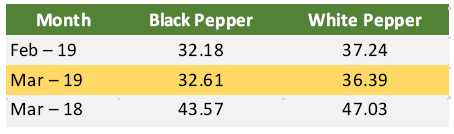
March price index showed mixed response. Price index of black pepper was reported to have experienced a marginal increase by 0.43 points as compared to February. However, it recorded a high 25% decline or 10.96 points when compared to the same month in 2018. Price index of white pepper for March recorded a slight decrease by 0.84 points when compared to the previous month and was reported at 36.39 points (Table 1). Thus, recording a decrease of 23% when compared with price index of white pepper on March 2018.
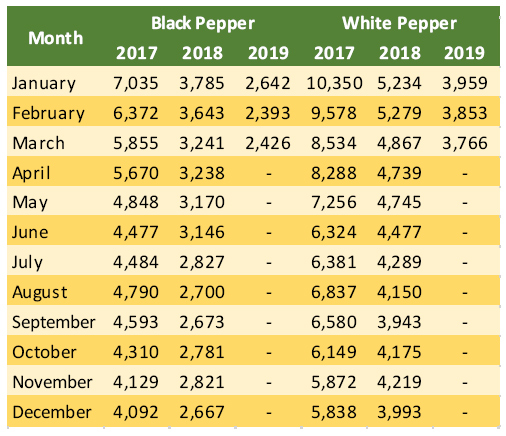
Composite prices of black and white pepper for March 2019 also experienced the same mixed response with composite price of black pepper being reported to have experienced a slight 1.3% or gaining USD 33 per Mt when compared to the previous month and was reported at USD 2,426 per Mt. Composite price of white pepper was reported with a deficit of 2.3% at USD 3,766 per Mt (Table 2), losing USD 87 per Mt when compared to the previous month.
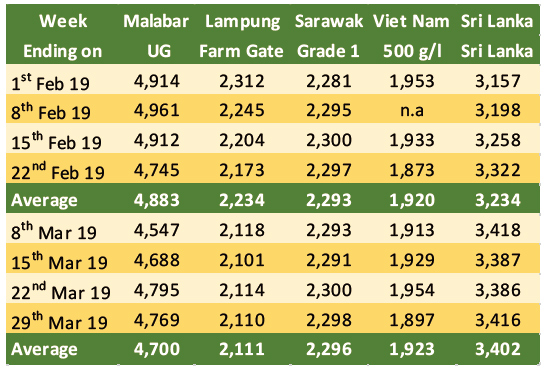
Pepper prices in the 3rd month of 2019 experienced a mixed trend. In India in the first week of March, the average price of black pepper was reported to be US$ 4,547 per Mt. In the following weeks pepper prices increased but in the last week of March experienced a slight decline. Despite the rising price trend, the average price of black pepper in India was still below the average price of black pepper in February. When compared with the previous month, the farm gate prices of black pepper in India decreased by 4%. Price declines in India occurred due to many factors, such as the harvest period in other countries so that the stock is high, and the effects of the entry of pepper from Viet Nam to India illegally. In Lampung (Indonesia) farm gate prices of black pepper were reported to decline by 6%. Low response from the market due to market demand had been fulfilled from other countries such as Viet Nam and Brazil, pushing prices to decline in Lampung. In addition, Indonesian currency fluctuations against the US Dollar was also one of the factors that caused the price of black pepper in Lampung to decline. In Malaysia and Viet Nam, the price of black pepper was relatively stable. Price fluctuations that occurred in March were caused by the movement of local currencies of the two countries against US Dollar. Malaysia and Viet Nam have a fairly good business strategy so that pepper from both countries could be absorbed quite large in the international market. Furthermore, the price of black pepper in Sri Lanka was reported to increase by up to 5%. With moderation production as well as maintaining their quality, Sri Lanka is able to manage the pepper market which caused Sri Lanka to be able to maintain a fairly good price just below India.
The continuous decline of pepper price needed to be addressed properly by stakeholders of pepper industry. One effort that could be applied is by campaigning to increase pepper consumption. The community needs to be educated with the benefits that will be obtained by consuming pepper. In addition, the industry needs to be encouraged to use pepper or pepper products. Furthermore, other solutions to overcome the problem of pepper prices that continue to decline can be done by increasing the production of pepper value added products. The use of pepper as an ingredient for snacks such as sweets which is being campaigned by Malaysia is a step that ought to be followed by other pepper producing countries. In addition, the use of pepper as a raw material for the perfume industry needs to be improved. India and Sri Lanka are countries that are able to process and produce pepper value added products well. Both countries are reported to be able to produce pepper oil, pepper oleoresin, green pepper, and other pepper value added products extensively. Value added products will increase the value of pepper as well as being able to absorb available pepper stock.
Learning from the phenomena that occurs in India, high awareness from stakeholders is needed to conduct a lucrative pepper business. Countries need to strengthen border areas so that illegal imports be stopped. In addition, pepper producing countries need to make strong brands which are well known by the international market. The use of brands that have high quality standards will be able to maintain the selling value of pepper. In addition, the use of brand will minimize fraud in the world of pepper trade.
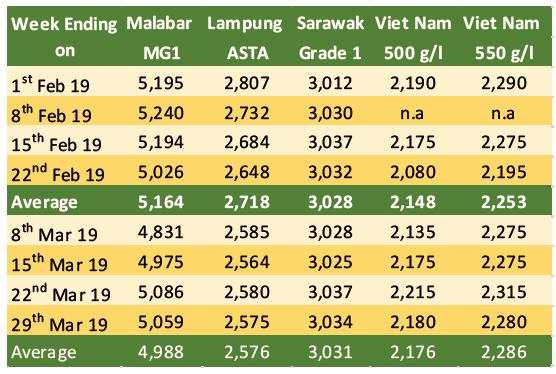
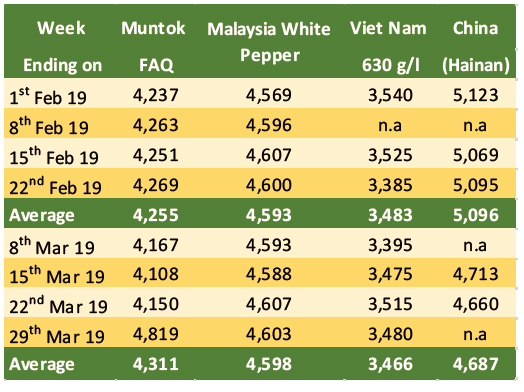
The price of white pepper in Indonesia and China were reported to have decreased. Farm gate prices of white pepper in Indonesia recorded a 2% decline while in China, it was reported to experience a decline of 8%. The abundance of white pepper stock due to the harvest in Viet Nam has caused market needs be met. The market was reported to be quiet with prices continued to decline. Meanwhile, in Malaysia and Viet Nam, prices were reported to be stable. Price changes in both countries were due to fluctuations in the local currency exchange rate against the US Dollar.
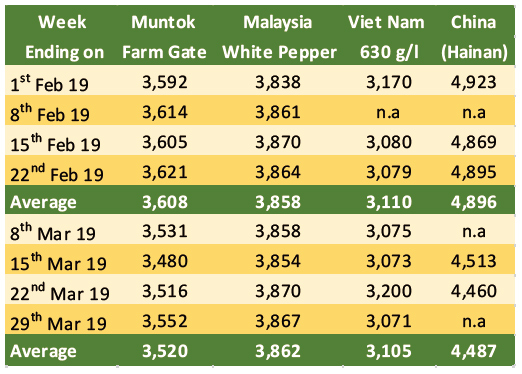
It cannot be denied that the main cause of the decline in the price of pepper is the overflowing stock of pepper. Following the law of supply and demand, if the stock is high but the demand is low, the price will decrease. The most concrete step that could be taken to increase pepper prices is to increase pepper demand or by reducing production.
Farmers and governments of pepper-producing countries need to be aware that at present, quality improvement is more important than increasing the quantity of pepper production. One country that has implemented production restrictions is Viet Nam. Viet Nam has prohibited opening of new pepper gardens. This step needs to be appreciated and copied by other countries. Producing countries need to focus on improving the quality of their pepper. The use of chemical products such as chemical fertilizers and synthetic chemical pesticides needs to be controlled and limited. In the future, the market will prefer products that have high quality standards, free from chemical residues, and been produced in ways that are environmentally friendly.
Pepper needs to be stored properly to avoid post-harvest disease. Conditions that are not optimal will cause the appearance of pests and warehouse pathogens. The presence of microorganisms can cause the emergence of aflatoxin which is harmful to human health.
FOCUS ON IMPORT OF PEPPER BY MAJOR CONSUMING COUNTRIES
AUSTRALIA
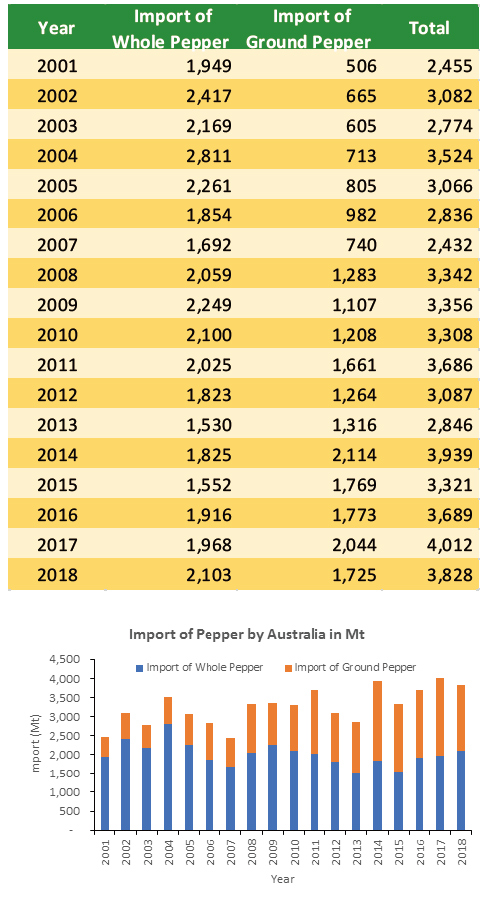
Australia has a climate that does not support pepper cultivation. Therefore, to meet domestic demands, Australia imports pepper from various pepper-producing countries. From 2001 to 2018, Australian pepper imports generally had an increasing trend. The highest pepper imports occurred in 2017 at 4.012 Mt, which comprised of 1,968 Mt whole pepper and 2,044 Mt ground pepper. In 2018 imports of pepper by Australia decreased, presumably because the remaining stock from the previous year was still quite high. In 2019, it is estimated that Australia will import a slightly more pepper than in 2018.
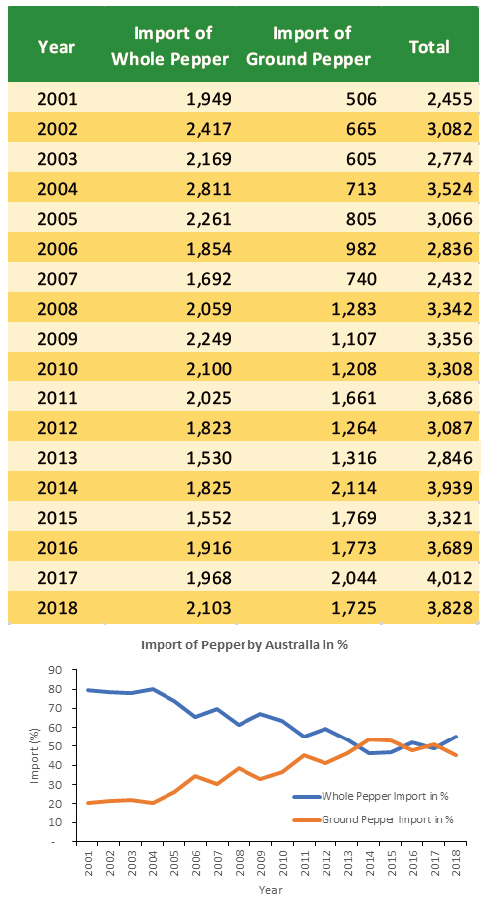
Based on data on types of pepper imported by Australia, there was a trend shift. From 2001 to 2013, Australia imported more on whole pepper. But starting 2014 Australia was reported to import more ground pepper than whole pepper. This trend shift could be seen from the declined number of whole pepper imports since 2001, while the number of imported ground pepper continued to increase. It is estimated that in the future Australia will import whole pepper and ground pepper with a ratio that is not too high.
This situation needs to be responded by producer countries by producing ground pepper that meets the quality standards recognized by Australia. Australian does not consume too much pepper, so the import of whole pepper will cause additional costs because it must first be processed into ground pepper before it is marketed. By importing ground pepper, processing costs in Australia will be minimized.
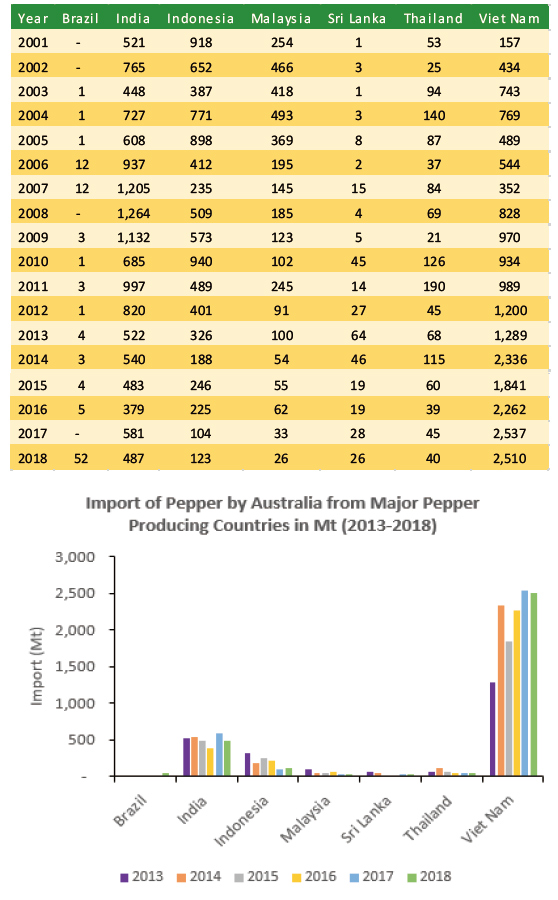
Based on its country of origin, most of the pepper imported by Australia comes from Viet Nam, followed by India, Indonesia and other countries. Australia also imports pepper from Malaysia, Thailand and Sri Lanka, but not too much. Imports from Viet Nam was reported to fluctuate over time, but from 2013 to 2018 there has been an increasing trend. Conversely, imports from Indonesia and Malaysia actually have a declining trend. Furthermore, imports from India also fluctuated, but were relatively stable.
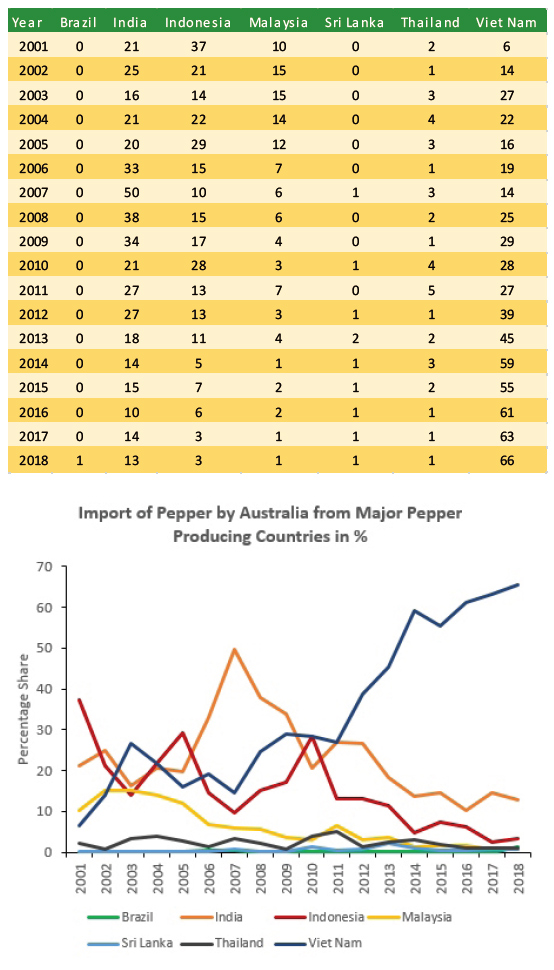
When compared to the total import quantity carried out by Australia, imports from Viet Nam showed an increasing ratio. This shows that Australia has a high level of trust in products from Viet Nam. Furthermore, the Import ratio from other pepper producing countries except India was reported to have a declining trend. The decline occurred because Australian pepper needs were met by the supply of pepper from Viet Nam. Furthermore, the import ratio from India was reported to be relatively stable even though it had increased in 2005 to 2007, and declined in 2007 to now.
UNITED STATES OF AMERICA (USA)
Being the third most populous country, America consumption of pepper is quite high. Tribal and ethnic diversity found in America causes pepper to be quite popular as a raw material for cuisine from certain ethnic and ethnic groups. In addition, pepper is also used as a marinade, rubs and condiment for meats and vegetables. Therefore, America imports enough pepper from pepper producing countries. In addition, pepper imports carried out by the United States are also used for pepper business activities such as pepper processing and pepper re-export to other countries. As a country that has high food safety standards, the products that enter America must have good quality and safe for human consumption.
From 2001 to 2018, pepper imports carried out by the United States were reported to fluctuate with the ever-increasing trend. The highest imports occurred in 2015 with a quantity of 80,359 Mt. In 2018, the United States reported to have imported 74,930 Mt of pepper, experiencing a slight decline from the previous year. In 2019 it is estimated that pepper imports by America will not differ greatly from imports in 2018.
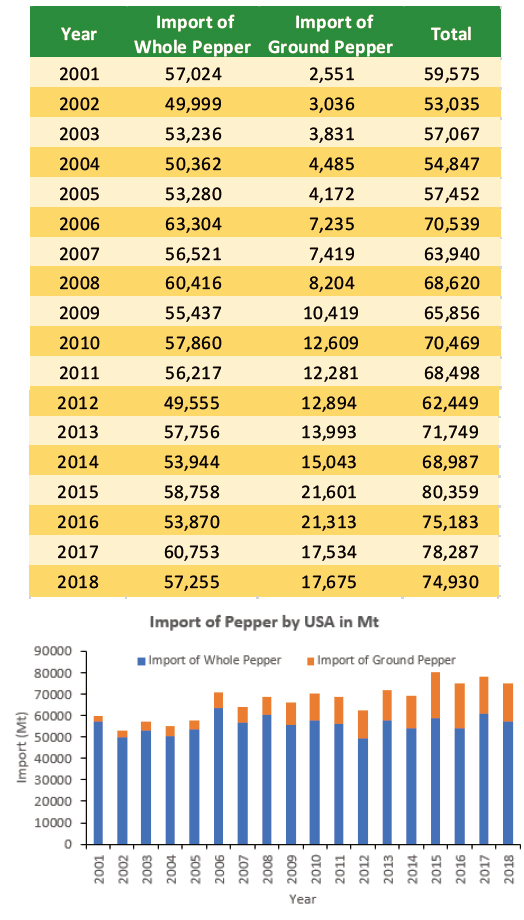
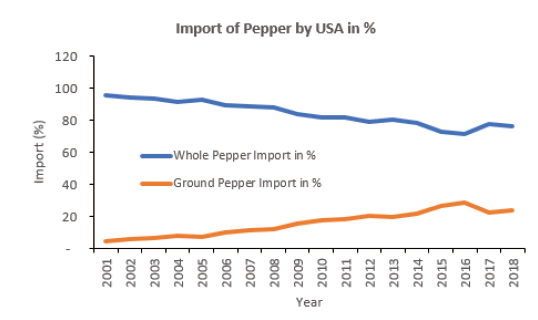
From 2001 to 2018, America showed a trend similar to Australia. If seen in the image of the imported pepper trend, Americans started to show interest in ground pepper. This can be seen from the number of whole pepper imports which continued to decline, while the number of imported ground pepper continued to increase. In the future, it is possible that the American import ratio between whole pepper and ground pepper will have a value that is not much different.
Based on its country of origin, America imports the most pepper from Viet Nam, followed by Indonesia, Brazil, India and other countries. Imports from Viet Nam show an increasing trend in the past 5 years. While imports from Indonesia and India actually show a declining trend. Furthermore, import from Brazil shows a stable trend. America also imports pepper from Sri Lanka and other countries, but in not too large amounts.
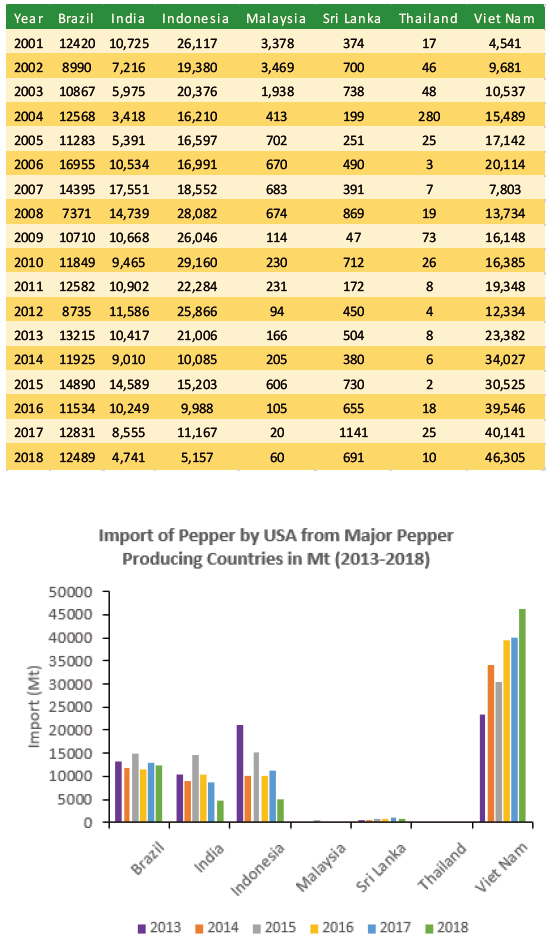
When compared with the total imports made by the United States, America's imports from Viet Nam have an increasing ratio. Since 2007 until 2018 the import ratio from Viet Nam had fluctuated, however it showed an increasing trend. Conversely, import ratios from Indonesia and India actually declined. Likewise, the import ratio from Malaysia continues to decline from time to time. The decline in the import ratio was due to the American market favouring pepper from Viet Nam. Pepper from Viet Nam is known for its relatively stable and inexpensive prices, which has been responded positively by the international market.
China
Some regions in China are known to have a suitable climate for pepper cultivation. However, pepper production in China has not been able to meet its domestic needs. China, being the most populous country in the world, is recorded to have the highest rate of pepper consumption in the world.
From 2001 to 2003 imports of pepper by China decreased. But since 2003 until 2018 imports of pepper by China had fluctuated with an increasing trend. China imports pepper to meet domestic needs, and little amount used for business purposes such as re-export. This official data might differ from actual figure of imports as a significant amount of pepper enter China illegally through bordering countries such as Viet Nam, Cambodia and Thailand.
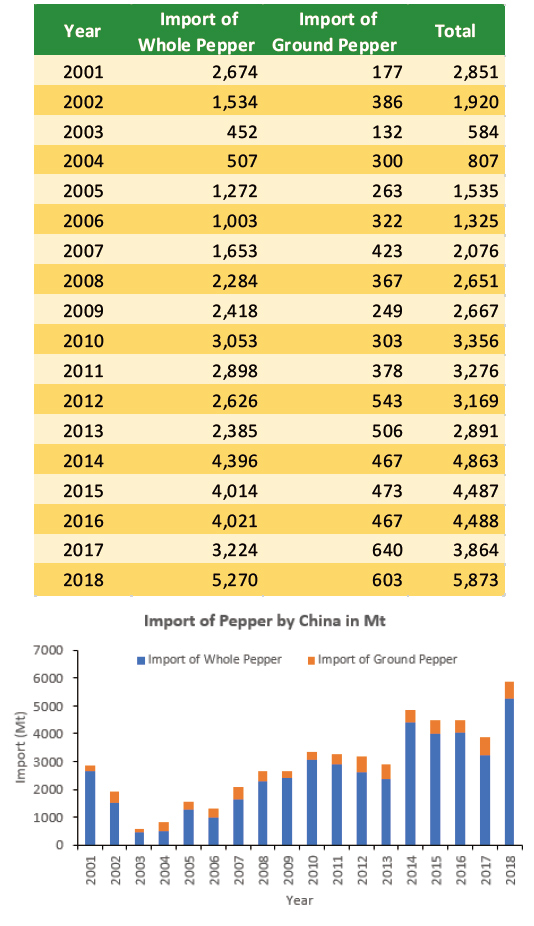
Slightly different from Australia and America, China's import showed that the country imports more whole pepper than ground pepper. Whole pepper is known to be less expensive and could be stored longer than ground pepper.
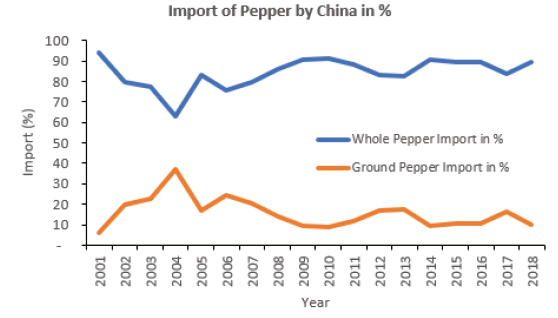
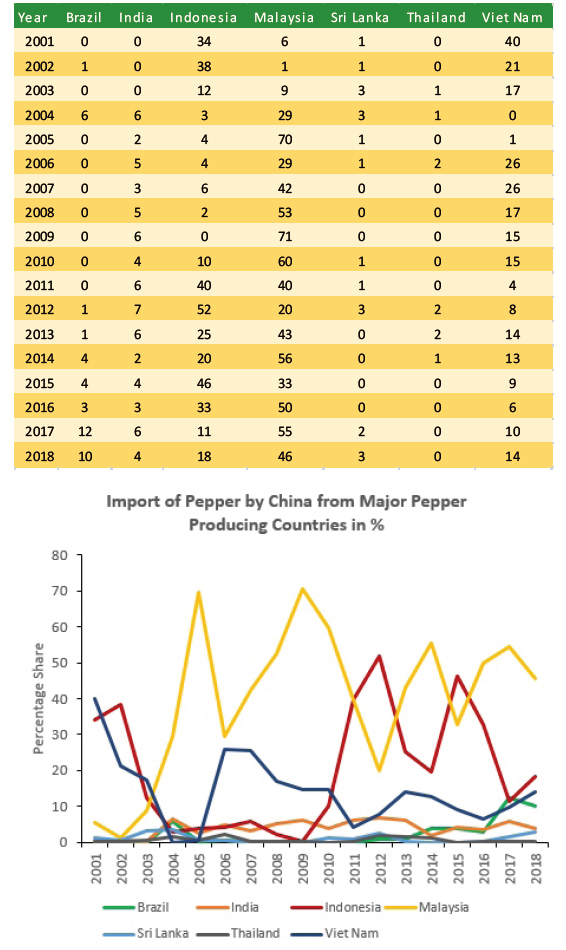
China imports a lot of pepper from Malaysia, Indonesia, Viet Nam, India, Brazil, Sri Lanka and other countries. Pepper from Malaysia had been the most imported by China in the last 5 years. The import trend by China over the past 5 years had reportedly fluctuated.
Pepper from Malaysia and Indonesia are in great demand by the Chinese market because pepper from both countries are of good quality. In addition, Indonesian pepper, Muntok White Pepper, is also known to have a distinctive aroma, and high piperine content that gives it a distinctive taste.
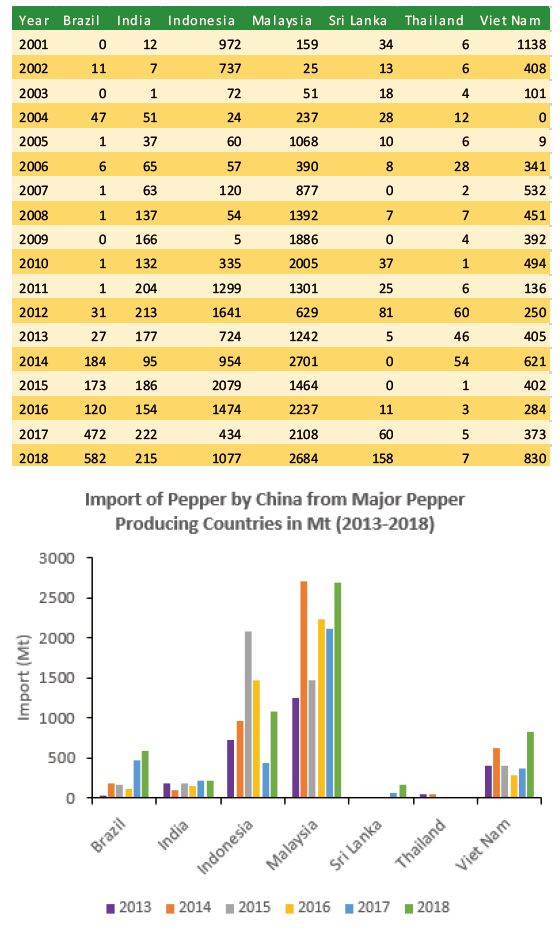
In 2001 China imported more pepper from Viet Nam than from Malaysia or Indonesia. But in 2018, China imported more pepper from Malaysia and Indonesia. The import ratio from Malaysia was reported to fluctuate, but still the highest. This shows that China trusted products from Malaysia and Indonesia.
Germany
German is one of the countries in Europe that imports quite a lot of pepper from various countries. Besides being used to meet domestic needs, German pepper imports are also used for business purposes such as pepper re-export. In general, pepper imports by Germany from 2001 to 2018 had fluctuated and had an increasing trend. In 2018 Germany imported 30,562 Mt of pepper consisting of 27,939 Mt of whole pepper and 2,623 Mt of ground pepper. In 2019, it is estimated that pepper imports by Germany will not differ greatly from imports in 2018.
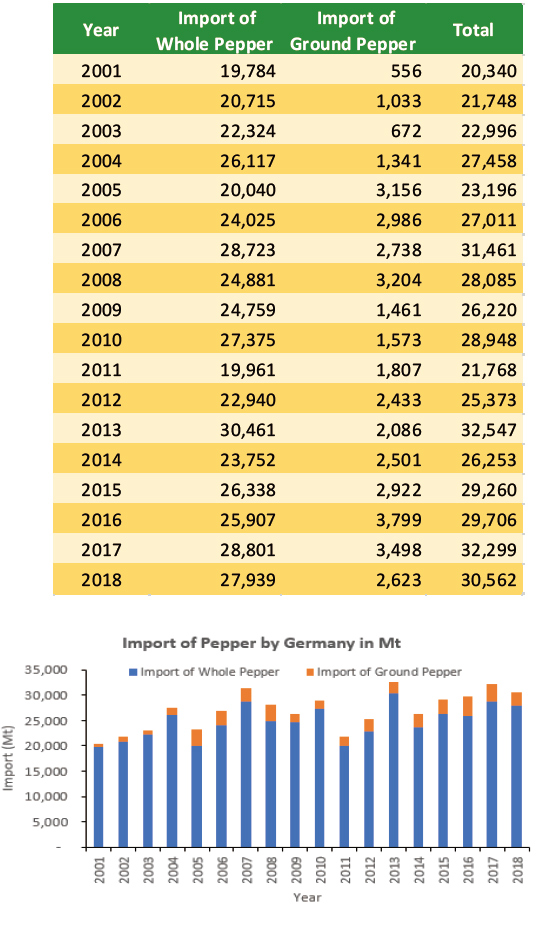
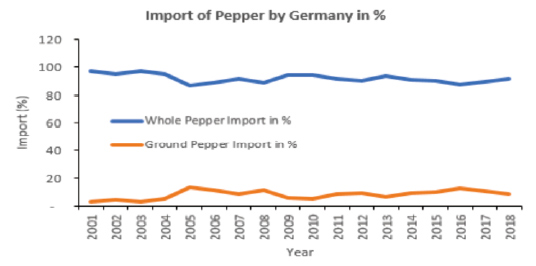
As a country that does business in re-exporting pepper to other consuming countries, Germany imports more whole pepper than ground pepper. Whole pepper has a cheaper price compared to ground pepper. Furthermore, whole pepper imported into Germany is processed and ground for sale at a higher price. With good technology, Germany is able to process whole pepper to be ground pepper with good quality, and able to package it into a product that has a high selling value.
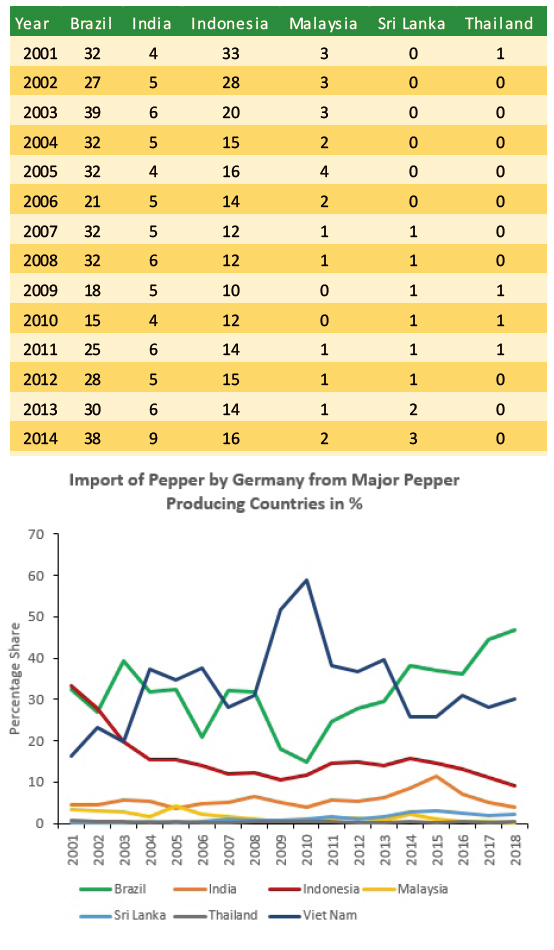
In the past five years, Germany had imported pepper from Brazil, Vietnam, Indonesia, India, Malaysia, Sri Lanka and Thailand. Prices of pepper from Brazil were cheaper than the prices of pepper from other countries. In addition, pepper from Brazil was also known to have good quality. As a country that does business in pepper, Germany currently prefers to import pepper from Brazil because of its low price so that it can obtain greater profits than if it imports pepper from Viet Nam or Indonesia. In addition, countries in Europe are known for their strict food safety regulations. This caused pepper from Viet Nam to be less attractive to Germany because of the issue of pesticide residues in pepper products from Viet Nam.
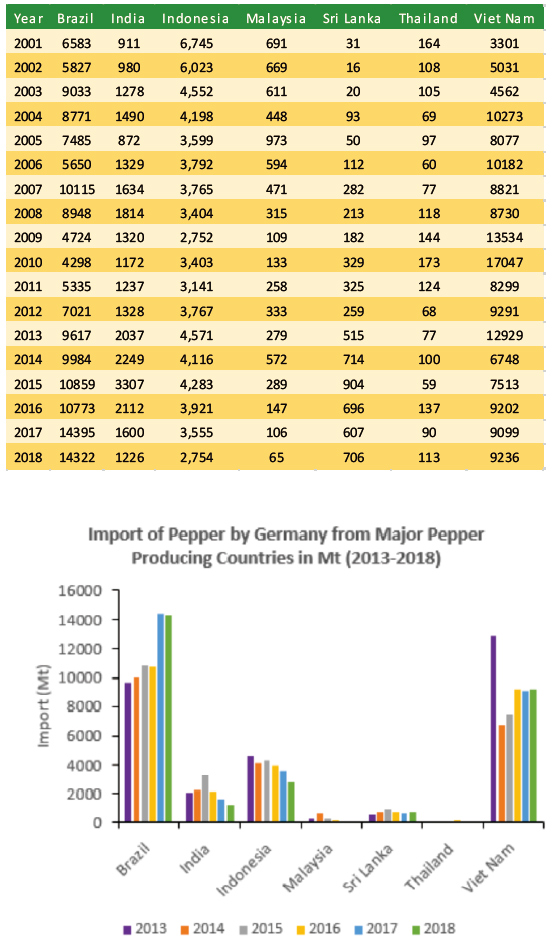
In 2018, the ratio of imports from Brazil was the highest followed by Viet Nam and Indonesia. Since 2001, the import ratio from Indonesia had a declining trend. The drastic decline occurred from 2001 to 2004. The import ratio from Brazil was reported to have started to increase since 2010. Increased import ratio from Brazil followed by a decrease in import ratio from Viet Nam. This showed that the European market is more trusting and prefers products from Brazil.
Previous Publications
- MARKET REVIEW DECEMBER 2025
- MARKET REVIEW NOVEMBER 2025
- MARKET REVIEW OCTOBER 2025
- MARKET REVIEW SEPTEMBER 2025
- MARKET REVIEW - AUGUST 2025
- MARKET REVIEW - JULY 2025
- MARKET REVIEW - JUNE 2025
- MARKET REVIEW - MAY 2025
- MARKET REVIEW - APRIL 2025
- MARKET REVIEW - MARCH 2025
- MARKET REVIEW - FEBRUARY 2025
- MARKET REVIEW - JANUARY 2025
- MARKET REVIEW - DECEMBER 2024
- MARKET REVIEW - NOVEMBER 2024
- MARKET REVIEW - OCTOBER 2024
- MARKET REVIEW - SEPTEMBER 2024
- MARKET REVIEW - AUGUST 2024
- MARKET REVIEW - JULY 2024
- MARKET REVIEW - JUNE 2024
- MARKET REVIEW - MAY 2024
- MARKET REVIEW - APRIL 2024
- MARKET REVIEW - MARCH 2024
- MARKET REVIEW - FEBRUARY 2024
- MARKET REVIEW - JANUARY 2024
- MARKET REVIEW - DECEMBER 2023