
a UNESCAP Intergovermental Organization
a UNESCAP Intergovermental Organization
Monthly Publication
Market Review - February 2017
GENERAL
It is observed that globally black pepper farmers are now facing a tough time with peak harvest staring in Asia and prices are remaining low. It is reported that crops in Brazil, India and Viet Nam are higher or similar to the last year. Clearly, global sentiment on black pepper is weak and buying from all major corners has slowed down. Recently some businesses have happened in the European market while the US and the Middle East markets are slow. Chinese buying has not started yet and this may turn the market any moments. In all origins, prices very close to cost of production leading to enormous resistance. Over the last two months large volume have been shipped out and expectedly March shipments to be very huge. These are bullish elements which would support the market in 2018.
In Viet Nam during February 2018, the market continued to be quiet although pepper harvest in Viet Nam was on an upswing trend. Trading in Viet Nam as the largest pepper supplier was limited, particularly in the second half of the month, in view of long holiday for celebrating Tet. Pepper price index in February 2018 decreased by 3.22 and 3.15 points respectively for black and white pepper (Table 1). The composite price of black pepper decreased by 6.1% to US$ 3,718 Mt from 3,958 in January 2018 while that of white pepper decreased by 6.2% from US$ 5,292 per Mt in January 2018 to US$ 4,967 in February 2018 (Table 2).
Table 1: IPC Price Index (Base Year: Average 2011 - 2015) 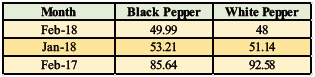
Table 2: Composite Price of Black and White Pepper (US$/MT) 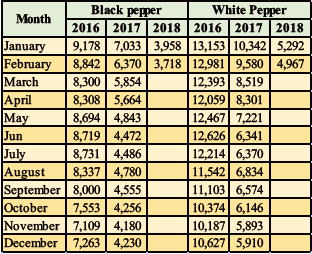
HIGHLIGHT ON VIET NAM 2017
Production and Export
Viet Nam is widely known as the largest pepper supplier in the last two decades. In Viet Nam pepper is cultivated mainly in Central Highland (Gia Lai, Dak Lak and Dak Nong provinces) and Southern East area (Dong Nai, Binh Phuoc and Ba Ria - Vung Tau provinces). As a result of continuous price increase in the last decade, pepper area expansion in the period of 2012 - 2017 increased very past. In 2010, the country planted pepper at only 51,000 hectares while in 2017 the planted area increased to reach 152,000 hectares, three times higher. Some source reported that pepper area in Dak Lak province has reached 21,000 hectares, much more than planned earlier of 16,000 hectares which earlier expected to be achieved in 2020. In Gia Lai province, more than 16,000 ha have been cultivated, recording around three times from original planning. Meanwhile, in Dak Nong the expansion is reported to have exceeded 4-fold. Uncontrolled area expansion has led to a significant growth in production that goes far beyond demand. The implication of this, pepper industry face serious problem of low price. This will likely continue into the next few years, unless there is genuine strategy from all stakeholders to reduce export or increase consumption both domestically and in the international market.
Rapid area expansion in the country has led Viet Nam becoming the leading country in pepper production and export. It was reported that together with import of around 35,000 Mt, Viet Nam has exported 215,000 Mt of pepper in 2017. Counting into account of estimated domestic consumption at around 10,000 Mt, production of pepper in 2017 would be minimum 190-200,000 Mt. It is understood that in the situation of low price, pepper harvested during the year was not totally sold out.
In 2018 production of pepper is estimated to remain high, at more or less the same as 2017 production. Although production of old plant decreased and unfavorable weather condition in flowering season in 2017, the decline however has been compensated by increased output from new pepper plants. Under the situation of low price level, increased production is not enough to meet the increasing cost of picking. As a result many farmers whose plants are less productive may consider to convert the plants to other crops.
Farmers holding stocks have suffering double losses. From every ton of pepper sold, they lose hundreds of millions Viet Nam Dong. In addition of the above, pepper farmers should bear the interest of bank loans for the cost of planting and expanding pepper made in previous seasons.
Table 3: Production and Export in MT 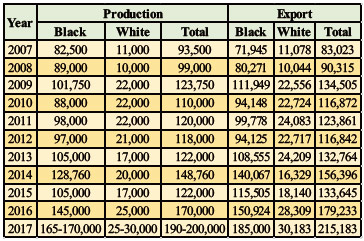
Note: break up of black and white pepper production and export is estimated.
Export and Import
In 2017 Viet Nam has exported 215,200 Mt of pepper, valued at US$ 1.12 billion to more than 100 countries of destinations, consisting of around 190,000 Mt of black and 25,000 Mt of white pepper. The export has increased substantially by 20 % from 179,200 Mt in 2016. In term of value however, the export has decreased by 22%. The United States of America continued to be the main destination, absorbing 18% (39,100 MT) of Vietnamese pepper. India and China, the two producing countries, also imported significant quantity of 16,200 Mt (8%) and 14,500 Mt (7%) respectively for internal and industrial uses. When compared to last year, the uptake USA to Vietnam\'s pepper decreased while for India and China increased. Other important market for Vietnamese pepper is the United Arab of Emirates imported 14,750 Mt, a marginal increase from previous year.
It is interesting to note that, Papua New Guinea emerged as the new important destination for Viet Nam imported 12,400 Mt in 2017. There is an assumption that substantial quantity of pepper goes to PNG in 2017 may transported to Indonesia by land since production of black pepper in Indonesian decreased significantly in the year. Other new important destination is Sri Lanka which imported 3,400 Mt from only 442 Mt in 2016. Export to Pakistan also increased significantly in the last two year too. It was reported some pepper imported by Pakistan and Sri Lanka from Viet Nam was re-exported to India for industrial uses. Table below shows export development from Viet Nam in 2012- 2017.
Table 4: Export of pepper from Viet Nam to twenty countries of destination in MT 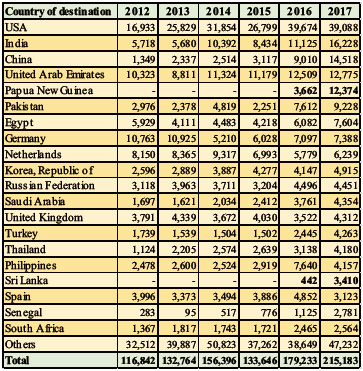
Beside exports huge quantity, Viet Nam also imported significant quantity mainly from Cambodia, Brazil and Indonesia. Viet Nam Pepper Association (VPA) estimated a volume of around 35,000 Mt was imported in 2017. According to official source, Viet Nam has imported pepper at a value of US$ 68 million in 2017. Assumed unit price of pepper imported in 2017 was between US$ 3,500 to 4,000 per Mt, total recorded import in 2017 was around 17,000-19,500 Mt. It means around 15,500-18,000 Mt of pepper import was unrecorded possibly in the form of cross border trade with its neighbors. Recorded import of pepper by Viet Nam in value term during 2012-2017 is shown below:
Table 5: Import of pepper by Viet Nam from ten countries of origin in US$\'000 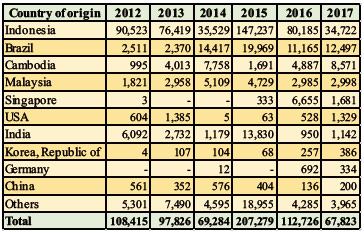
Price
The price of pepper in Viet Nam slipped down significantly. In addition to the quality factor, the main reason for the fall in prices is the offer exceeds demand.
As reported earlier, production and export of pepper in Viet Nam increased significantly in the last two years and Viet Nam occupies more than 50% of world pepper export hence any development in Viet Nam will affect global market. As a result of the above development, pepper price decreased significantly over the last two years.
In February 2018 local price of black pepper in Viet Nam decreased from VND 66,500 per Kg to VND 62,000 per Kg at the month\'s close. On an average the price was VND 64,250 per Kg, showing a decrease of 3% when compared to previous month average at the level of VND 66,500 per Kg. The price also dropped by 50% from the average price in early 2017. In respect of white pepper the price reported stable at VND 107,500 per Kg during the last two months.
FOB prices decreased by US$ 50 per Mt to US$ 3,500 per Mt for black 550/L while for white pepper increased marginally by US$ 100 per Mt to 5,150 Mt at the month\'s close. When compared to FOB price in February 2017, the price decreased by 40% from US$ 5,850 for black and 43% from US$ 8,960 for white pepper.
Pepper harvest is currently on upswing trend and is estimated the output would be same as last year, with a slight increase as a result of new pepper plants has started produce pepper. The market in February was not very active particularly in the second half of the month in view of most players in Viet Nam celebrating Tet. Activity is expected to increase in March, where new material from current harvest starts arrived in the market. Under this situation as mentioned above it is difficult to expect the price increase in the near future.
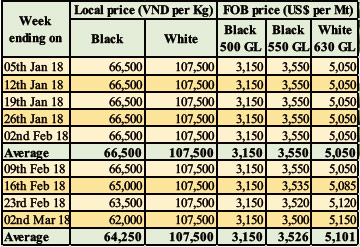
Table 7: Monthly average price of pepper in Viet Nam 2017 - February 2018 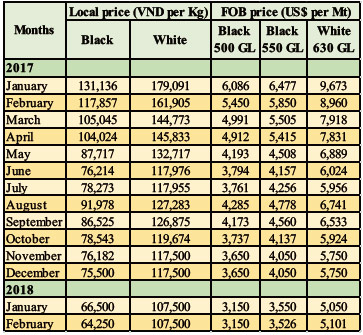
Previous Publications
- MARKET REVIEW - NOVEMBER 2023
- MARKET REVIEW - OCTOBER 2023
- MARKET REVIEW - SEPTEMBER 2023
- MARKET REVIEW - AUGUST 2023
- MARKET REVIEW - JULY 2023
- MARKET REVIEW - JUNE 2023
- MARKET REVIEW - MAY 2023
- MARKET REVIEW - APRIL 2023
- MARKET REVIEW - MARCH 2023
- MARKET REVIEW - FEBRUARY 2023
- MARKET REVIEW - JANUARY 2023
- MARKET REVIEW - DECEMBER 2022
- MARKET REVIEW - NOVEMBER 2022
- MARKET REVIEW - OCTOBER 2022
- MARKET REVIEW - SEPTEMBER 2022
- MARKET REVIEW - AUGUST 2022
- MARKET REVIEW - July 2022
- MARKET REVIEW - June 2022
- MARKET REVIEW - MAY 2022
- MARKET REVIEW - APRIL 2022
- MARKET REVIEW - March 2022
- MARKET REVIEW - February 2022
- MARKET REVIEW - January 2022
- MARKET REVIEW - December 2021
- MARKET REVIEW - November 2021