
a UNESCAP Intergovermental Organization
a UNESCAP Intergovermental Organization
Monthly Publication
Market Review - August 2018
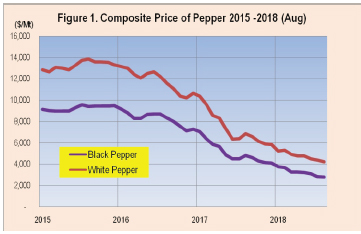
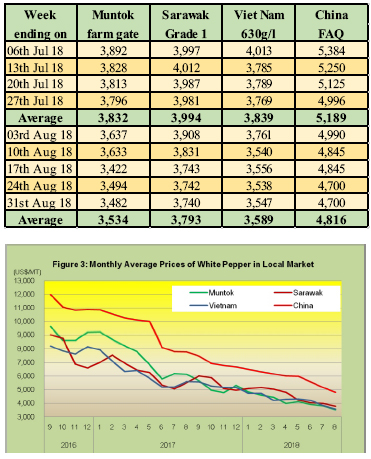
During the last three years, pepper prices decreased significantly by around 70% from US$ 9,400 per Mt for black and US$ 13,800 per Mt for white pepper recorded in August 2015 to US$ 2,785 and US$ 4,200 per Mt respectively for black and white pepper in August 2018, as shown in the Figure 1. Substantial increase of production in Viet Nam and Brazil during 2016, 2017 and continue till 2018 were likely the main factor affecting the significant decrease.
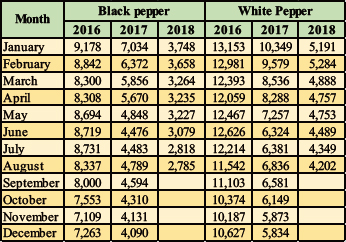
Price index of pepper during August 2018 decreased marginally, by 0.43 and 1.42 points for black and white pepper respectively (Table1). The composite price of black pepper decreased by 1.1% to US$ 2,785 per Mt from US$ 2,818 in July 2018; while that of white pepper price decreased by 3.4% from US$ 4,349 per Mt in July 2018 to US$ 4,202 in August 2018 (Table 2).
Table 1. IPC Price Index (Base price: Average 2011 - 2015)
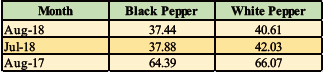
Table 2: Composite Price of Black and White Pepper (US$/MT)
In August 2018 pepper market showed a mix response. Except in India price of pepper continued to decrease. Flood incident occurred in Kerala, the main pepper producing state, has influenced pepper price up. On the contrary, pepper prices in other producing countries decreased further because this year's pepper production is still quite large, mainly in Viet Nam and Brazil, particularly in Espirito Santo, Southern of Brazil.
Table 3: Local Price of Black Pepper in US$ per Mt
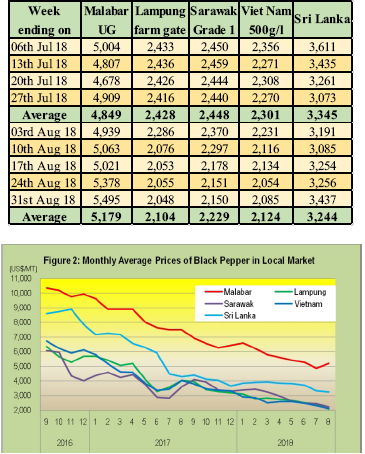
Table 4: Local Price of White Pepper in US$ per Mt
Production Estimate in 2018
As a result of massive expansion of pepper area in Brazil, particularly in Espirito Santo, production of pepper in the last few years increased significantly from 41,500 Mt in 2016 to 65,000 Mt in 2017 and in 2018 is estimated to increase further to 72,000 Mt. Production of pepper in Viet Nam also increased significantly from 122,000 Mt in 2015 to 170,000 in 2016 and 200,000 in 2017. Although production of pepper in Viet Nam during 2018 was reported to have a marginal decrease, sufficient stock carry forward from previous harvest has made further pressure this year.
In Indonesia production of pepper is estimated to be more or less same as last year. Production of black pepper in Lampung decreased, while production of white pepper increased. It is interesting to note that portion of black pepper production in Indonesia decreased year by year; while production of white pepper remain stable even increased, as reflected in total export realized in the last three years as shown below.
Table 5. Export of black and white pepper from Indonesia in Mt
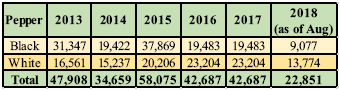
As already noticed, that black pepper from Indonesia is widely known as Lampung black, which is produced in Lampung province and its neighboring areas in Bengkulu and South Sumatera provinces. Due to climatic condition as well as continued price decrease, production of black pepper in these regions in the last few years has experienced a continuous decrease.
In the case of white pepper; production of white pepper in Indonesia has experienced an increasing trend, particularly supported by production increase of white pepper in non traditional source such as in East Kalimantan and South Sulawesi. Production from these regions has increased and compensated production decrease at traditional source, particularly in Lampung. Production of white pepper in 2017 increased from 35,000 Mt in 2016 to 42,000 Mt in 2017; while for black pepper decreased to 33,000 Mt from 42,000 Mt in 2016. In 2018 production of black pepper is estimated to decrease further, while for white pepper a marginal increase is anticipated. Overall production in 2018 will be more or less same as last year.
In Malaysia, production of pepper is estimated to remain stable as around 23,500 Mt; while production is Sri Lanka is estimated to decrease significantly from 29,000 Mt in 2017 to 18,000 Mt this year.
Considering the above assessment, pepper market is currently predominantly controlled by Vietnamese pepper players. Since more than 90% of Brazilian pepper is exported, a substantial increase of production in the country has also contributed significantly for the decrease. Pepper harvest in Central highlands of Viet Nam and Espirito Santo of Brazil has completed in the first semester. In Para State of Brazil, main harvest will take place in September, but the output is not as good as last year. Any development in these sources will influence global market direction. In the near future, it is estimated the price will fluctuate at narrow range as upcoming crop season in India in December is anticipated to decrease affected by flood incident.
Previous Publications
- MARKET REVIEW - NOVEMBER 2023
- MARKET REVIEW - OCTOBER 2023
- MARKET REVIEW - SEPTEMBER 2023
- MARKET REVIEW - AUGUST 2023
- MARKET REVIEW - JULY 2023
- MARKET REVIEW - JUNE 2023
- MARKET REVIEW - MAY 2023
- MARKET REVIEW - APRIL 2023
- MARKET REVIEW - MARCH 2023
- MARKET REVIEW - FEBRUARY 2023
- MARKET REVIEW - JANUARY 2023
- MARKET REVIEW - DECEMBER 2022
- MARKET REVIEW - NOVEMBER 2022
- MARKET REVIEW - OCTOBER 2022
- MARKET REVIEW - SEPTEMBER 2022
- MARKET REVIEW - AUGUST 2022
- MARKET REVIEW - July 2022
- MARKET REVIEW - June 2022
- MARKET REVIEW - MAY 2022
- MARKET REVIEW - APRIL 2022
- MARKET REVIEW - March 2022
- MARKET REVIEW - February 2022
- MARKET REVIEW - January 2022
- MARKET REVIEW - December 2021
- MARKET REVIEW - November 2021