
a UNESCAP Intergovermental Organization
a UNESCAP Intergovermental Organization
Monthly Publication
MARKET REVIEW - January 2020
PRICE HISTORY
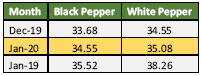
The year 2020 was opened with a positive outlook as price index was reported favourably. January 2020 saw the price index of black pepper with an increase of 2.6% as compared with December 2019 at 34.55 point. However, when compared with January 2019, the price index for black pepper experienced 3% loss. Though not as high as price index of black pepper, price index of white pepper for January 2020 was also reported with an increase, as it recorded a 1.5% increase when compared with December 2019 though it recorded a decrease by 8% when compared with January 2019. The price index of white pepper in was reported at 35.08 point (Table 1).
Table 1. IPC Price Index (Base price: Average 2011-2015)
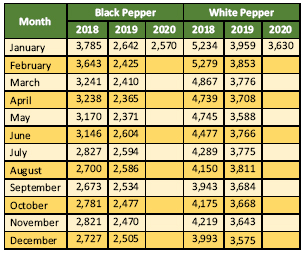
Composite price of black and white pepper at the opening of 2020 was reported positively. Composite price of black pepper in January was reported at USD 2,570 per Mt, recording an increase of 2.6% or USD 65 per Mt when compared with December 2019. In line with composite black pepper, composite price of white pepper at the first month of 2020 was also reported favourably at USD 3,630 per Mt, recording an increase of USD 55 per Mt as compared with December 2019.
Table 2. Composite Price of Black and White Pepper (US$/Mt)
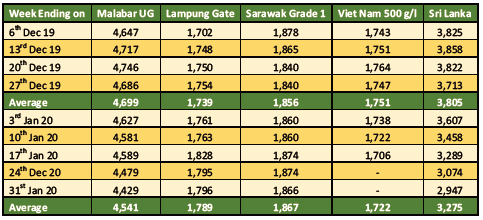
Pepper prices at the beginning of 2020, showed a mixed response with Sri Lanka origin recorded the highest decrease as opposed to the previous month in December 2019. The farm gate price of black pepper in India was reported with a decrease by 3% as opposed to December at an average of USD 4,541 per Mt (Table 3). In the local currency farm gate price of India black pepper was traded at an average of INR 322 per Kg. The decrease of India black pepper price could be contributed to the harvest season currently in full swing, thus, pushing down the local price.
The price of black pepper in Indonesia (Lampung black pepper) was reported with an increase of 3% as opposed to the previous month with an average of USD 1,789 per Mt. The increase of Indonesia black pepper could be contributed to the decreasing of pepper stock in market and the strengthening of Indonesia's local currency against the US Dollar (IDR 13,732 for USD 1) by 2% as compared with December 2019.
In January 2020, the farm gate price of Malaysia's black pepper was reported with an increase of 1% as compared to the previous month at an average of USD 1,867 per Mt. The increase of Malaysia black pepper also could be contributed to the strengthening of Malaysia's local currency by 2% against the US Dollar (MYR 4.08 for USD 1) when compared with the December.
Having been inactive for the last two weeks of January 2020 due to celebration of Lunar New Year, farm gate price of black pepper in Viet Nam was reported to have decreased by 2% as opposed to December averaging at USD 1,722 per Mt. Whilst, Sri Lanka black pepper was reported with a staggering 14% deficit as opposed to December and was reported at an average of USD 3,275 per Mt.
Table 3. Farm Gate Prices of Black Pepper (US$ per Mt)
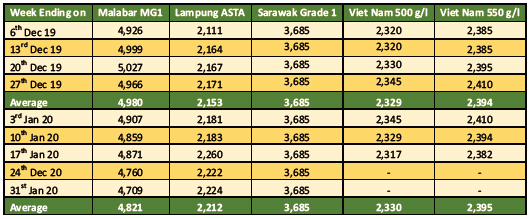
FOB price of black pepper for January 2020 showed a mixed response with only Indonesia origin recorded an increase. India was reported with the same 3% decrease when compared to the December at an average of USD 4,821 per Mt (Table 4). Furthermore, the FOB price of black pepper in Indonesia was reported with an increase of 3% as opposed to December averaging at USD 2,212 per Mt. FOB price of Malaysian black pepper was reported stable at an average of USD 3,685 per Mt. Furthermore, contrary to local market FOB price of Viet Nam black pepper 500 g/l and 550 g/l were reported stable at an average of USD 2,330 per Mt and USD 2,395 per Mt respectively.
Table 4. FOB Prices of Black Pepper (US$ per Mt)
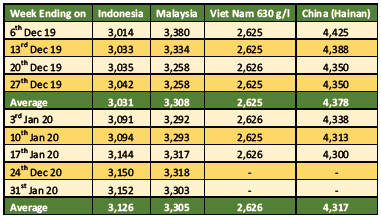
Farm gate prices of white pepper in January 2020 also showed a mixed response (Table 5) with only Indonesia origin was reported an increase. Muntok white pepper was reported with an increase of 3% as compared to December and was traded at an average of USD 3,126 per Mt. In local currency, the price of Muntok white pepper increased to an average of IDR 43,000 per Kg from IDR 42,550 per Kg. Farm gate price of Malaysia white pepper was reported stable and was traded at an average of USD 3,305 per Mt. Furthermore, Viet Nam white pepper was also reported stable at an average of USD 2,626 per Mt. Whilst, similar to Viet Nam market, having been inactive in the last two weeks of January 2020, China white pepper was traded with 1% deficit as opposed to December at an average of USD 4,317 per Mt.
Table 5. Farm Gate Prices of White Pepper (US$ per Mt)
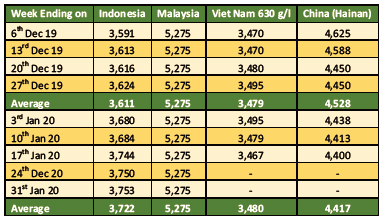
FOB price of white pepper showed a mixed response with only Indonesia origin was reported with an increase. FOB price of Indonesia white pepper for January 2020 was reported with an increase of 3% when compared to December and was reported at an average of USD 3,722 per Mt. Furthermore, FOB price of Malaysia white pepper continued to be reported stable and unchanged. FOB price of Viet Nam white pepper was also reported stable averaging at USD 3,480 per Mt. Whilst, FOB price of white pepper in China was reported with a deficit by 2% when compared to December and was traded at an average of USD 4,417 per Mt (Table 6).
Table 6. FOB Prices of White Pepper (US$ per Mt)
HIGHLIGHT ON CHLORPYRIFOS
How European Union Come to Ban Chlorpyrifos and Chlorpyrifos-methyl
In a pivotal move, the European Union on 13 January 2020 has released Commission Implementing Regulations which stipulated the non-renewal of the approval of active substances chlorpyrifos and chlorpyrifos-methyl after the European Food Safety Agency's found both substances were unable to meet the approval criteria applicable to human health. This move would mean the banning of chlorpyrifos and chlorpyrifos-methyl for food.
What are chlorpyrifos and chlorpyrifos-methyl
Chlorpyrifos
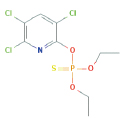 Possessing a molecular formula of C9H11CI3NO3PS, chlorpyrifos is a colorless to white crystalline solid organophosphate insecticide, acaricide and miticide with a strong odor which is used to control foliage and soil-borne insect pests on variety of food and feed crops. This non-water-soluble substance which has been widely used in homes and on farms; in home to control cockroaches, fleas and termites while in farms to control ticks on cattle and as a spray to control crop pests, usually need to be mixed with oily liquid before applying it to crops or animals. Chlorpyrifos works by affecting the nervous system of people, pets and other animals the same way it affects the target pest. Chlorpyrifos can inhibit the nervous system enzyme acetyl cholinesterase in humans which leads to overstimulation of the nervous system causing nausea, dizziness and confusion. At very high exposures (from spills or accidents), repository arrest and death can occur.
Chlorpyrifos-methyl
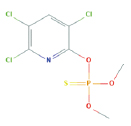
Chlorpyrifos-methyl which molecular name is C7H7CI3NO3PS, is an organophosphate pesticide used to control insects on fruits, vegetables and cereal plants. This substance which commonly used to control insects in grain storage areas, comes in the form of granular crystalline solid with a mercaptan odor. Though insoluble in water this substance is soluble in acetone, acetonitrile, benzene, carbon disulphide, carbon tetrachloride, chloroform, diethyl ether. Ethanol, methanol, n-octanol and hexane. Chlorpyrifos-methyl may cause an allergic skin reaction and very toxic to aquatic life.
Pesticide with active substance Chlorpyrifos and Chlorpyrifos-methyl
Chlorpyrifos and Chlorpyrifos-methyl as an active substance in pesticide are very well known and actively used worldwide. They are reported to have been registered for use in 100 countries in the world and for the use of over 50 crops.
Below are some major crops that used pesticide with active substance chlorpyrifos and chlorpyrifos-methyl:
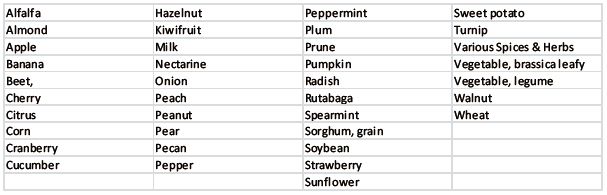
Pesticide with active substance of chlorpyrifos and chlorpyrifos-methyl is also widely used for spices crops which includes pepper (Black, White and Green). Thus, the use of pesticide with both active substances is highly significant in pepper producing country like India, Indonesia, Malaysia and Viet Nam whilst Sri Lanka banned the use of pesticide with active substance chlorpyrifos since 2014.
List of Licensed/Registered Pesticide with chlorpyrifos or chlorpyrifos-methyl in Pepper Producing countries:
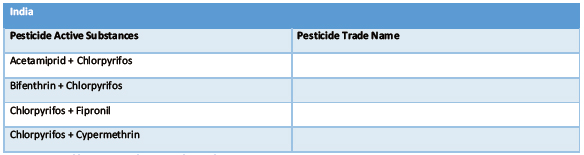
Source: http://ppqs.gov.in/divisions/cib-rc/registered-products and IPC's findings.
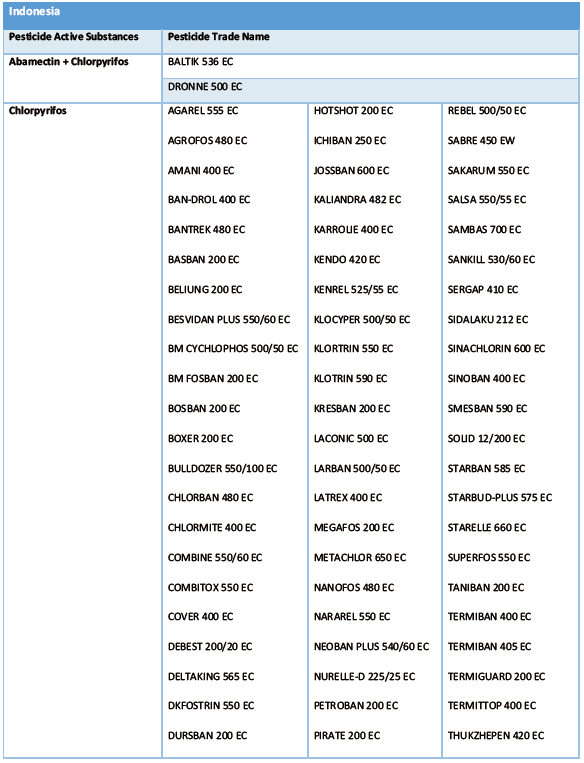
Source: http://pestisida.id/simpes_app/rekap_kimia_formula.php?s_keyword=klorpirifos&rekap_kimia_formula1Page=2 and IPC's findings.
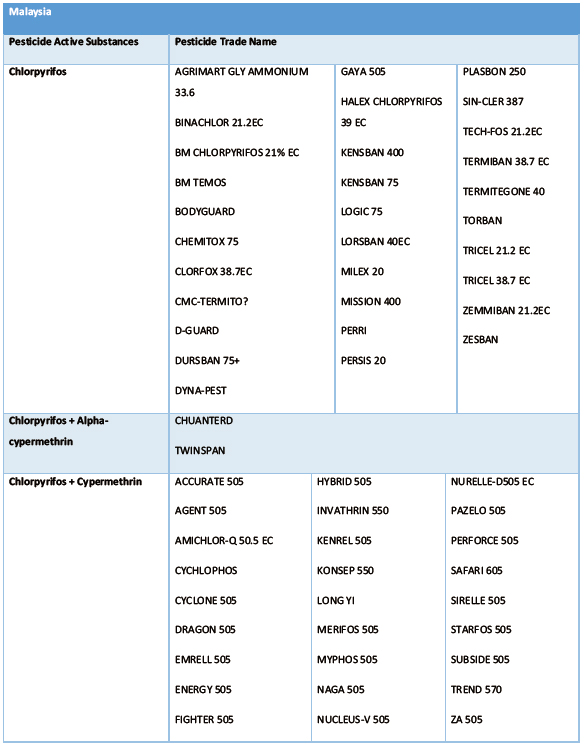
Source: http://www.portal.doa.gov.my/sismarp/welcome/searchperawis?search=Chlorpyrifos
and IPC's findings.
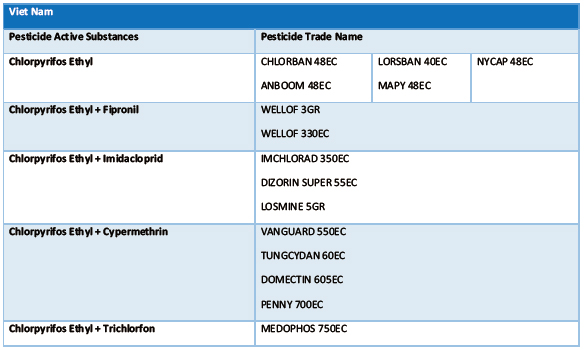
Source: Plant Protection Department-Ministry of Agriculture and Rural Development and IPC's Findings
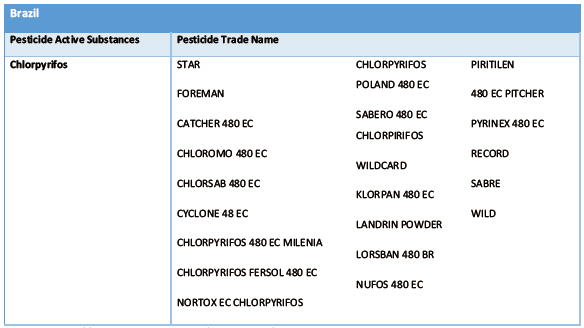
Source: https://www.agrolink.com.br/agrolinkfito/busca-direta-produto and IPC's findings.
European Food Safety Authority Declared Chlorpyrifos Unable to Meet Criteria Applicable to Human Health
In July 2019, the European Commission mandated European Food Safety Authority to provide statement on the available outcomes of the human health assessment in the context of the pesticides peer review expert discussion in mammalian toxicology, held between 01 - 05 April 2019, for the renewal of approval of the active substance chlorpyrifos.
After considering the main finding of the assessment related to mammalian toxicology and human health of the Pesticides Peer Review Expert Discussion as well as EFSA's additional consideration, EFSA considered chlorpyrifos "does not meet the approval criteria which are applicable to human health as laid down in Article 4 of Regulation (EC) No. 1107/2009."
The following is the excerpt of the conclusion of EFSA Statement as published on EFSA Journal dated 31 July 2019:
Conclusions
During the Pesticides Peer Review 01 Experts' meeting in April 2019, all the experts, except one, agreed that the Point of Departure (PoD) for chlorpyrifos should be the DNT LOAEL of 0.3 mg/kg. With regard to the uncertainty factors the experts went through the overall assessment and concluded that:
- The genotoxicity potential remains unclarified (positive findings from an in vitro chromosome aberration study and two in vitro unscheduled DNA synthesis assays; in vivo positive findings from open literature on chromosome aberration and on DNA damage caused through oxidative stress or by topoisomerase II inhibition which was considered a MIE for infant leukemia);
- The effects recorded in the DNT study (decrease in cerebellum height corrected by brain weight already at the lowest dose tested, which is a relevant endpoint for hazard characterization) indicate a concern;
- The epidemiological evidence supports the developmental neurological outcomes in children for chlorpyrifos
Overall, no reference values could in any case be set because of the unclear genotoxicity potential of chlorpyrifos; moreover, significant uncertainties were linked to the neurodevelopmental toxicity study, where effects were observed at the lowest dose tested in rats (decrease in cerebellum height corrected by brain weight). These concerns were supported by the available epidemiological evidence related to developmental neurological outcomes in children. In the absence of toxicological reference values, a risk assessment for consumers, operators, workers, bystanders and residents cannot be conducted. This issue represents a critical area of concern for chlorpyrifos.
In addition, the recorded toxicological effects meet the criteria for classification as toxic for reproduction category 1B (regarding developmental toxicity).
Based on the above it is considered that the approval criteria which are applicable to human health as laid down in Article 4 of Regulation (EC) No 1107/2009 are not met.
EU Countries Voted to Ban Chlorpyrifos and Chlorpyrifos-methyl
In response to the statement released by European Food Safety Authority which elaborated that pesticide chlorpyrifos does not meet the approval criteria applicable to human health following some concerns on the epidemiological evidence related to developmental neurological outcomes in children as well as the absence of toxicological reference values, the EU countries had voted to ban pesticide containing active substance chlorpyrifos entirely from European Markets. This historical move took place in a meeting of the standing committee on plants, animals, food and feed (SCOPAFF) on 6 December 2019.
Soon after the meeting of the standing committee on plants, animals, food and feed (SCOPAFF) on 6 December 2019, European Union Commission sent out notification documents to the World Trade Organization (WTO) on 12 December 2019 which then recorded as WTO Notification No. G/SPS/N/EU/360. The WTO Notification contained the draft Commission Regulation (EU) amending Annexes II and V to Regulation (EC) No. 396/2005 of the European Parliament and of the Council as regards maximum residue levels (MRLs) for chlorpyrifos and chlorpyrifos-methyl in or on certain product. The proposed draft of the Commission Regulation (EU) which regulated that the MRLs for chlorpyrifos and chlorpyrifos-methyl on all product be lowered.
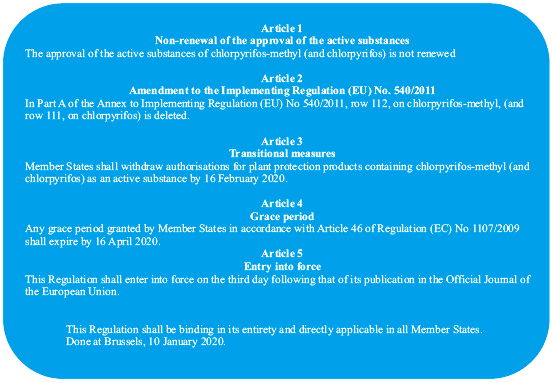
Furthermore, following the voting to ban chlorpyrifos and the sending of notification to WTO, European Union Commission through its official journal of the European Union dated 13 January 2020 published Commission Implementing Regulation EU 2020/17 and EU 2020/18 stipulating the non-renewal of the approval of the active substance chlorpyrifos and chlorpyrifos-methyl respectively. The Commission Implementing Regulations EU 2020/17 and EU 2020/18 adopted the following regulation:
Reaction of the Spice Industry
In response to EU move on banning the use of active substance chlorpyrifos and chlorpyrifos-methyl, reactions from different element of the spice industry were reported as the spice industry is an inherently global industry that supports the livelihood of farmers in many developing countries. Thus, the lowering of the MRLs for chlorpyrifos and chlorpyrifos-methyl by the European Union, as the biggest single market in the world, would cause a major disruption in the spices industry supply chain.
International Pepper Community (IPC) as the representative of its member which are pepper producing countries have coordinated with Government and the industry in this regard. IPC had sent letter to European Commissioner for Health and Food Safety on 17 January 2020 requesting a longer transitional period for IPC member countries to comply with the new regulation. In addition to IPC letter, individual member country of the IPC namely Malaysia and Viet Nam had corresponded in January 2020 requesting EU to reconsider the imposition of the new MRLs and to consider extending a more feasible transitional period. IPC have also liaised with the industry such as European Spice Association (ESA), International Organization of Spices Trade Association (IOSTA), American Spice Trade Association (ASTA) and other relevant organization to send comments to the WTO so as able to provide sufficient justification to WTO in order to hold on EU notification request.
The European Spice Association (ESA) which more than 400 members are European-based company from spice sector, as the representative of the spice processing industry in Europe corresponded with European Commission on 7 February 2020 and requested an appropriate transitional period of 2 years until the new MRLs entered into force as well as exemption for already manufactured products that are currently on the market.
The same tone of request as ESA was also conveyed by the International Organization of Spices Trade Association (IOSTA), representative of the global spice industry which include local trade association in growing regions and importing countries, on their letter dated 10 February 2020 to the European Commission. In their letter IOSTA requested; an exemption for products currently on store shelves; a more reasonable transition time until 2023 and that the establishment of the MRLs basing on technical feasibility, taking into account unavoidable supply chain challenges and environmental persistence of the chemical.
What's Next for Chlorpyrifos and Chlorpyrifos-methyl in Europe
With Commission Implementation Regulation EU 2020/17 and EU 2020/18 which came into force on 16 January 2020, European countries were required to withdraw authorisations for pesticide containing chlorpyrifos and chlorpyrifos-methyl by 16 February 2020 with grace period permitted until 16 April 2020.
In addition the Standing Committee on Plants, Animals, Food and Feed section Phytopharmaceutical - Residues is scheduled to convene on a meeting during 17 - 18 February 2020 in which one of the agenda of discussion is exchange of views and possible opinion of the Committee on a draft Commission Regulation EU amending Annexes II and V to Regulation (EC) No. 396/2005 of the European Parliament and of the Council as regards maximum residue levels for chlorpyrifos and chlorpyrifos-methyl in and on certain products. Upon the adoption of the aforementioned draft Commission Regulation, the maximum residue levels of all product for active substance chlorpyrifos and chlorpyrifos-methyl will be lowered to 0.01 mg/kg and would come into force in October 2020.
With the new MRLs coming into force in October 2020, the downstream stakeholders of agricultural industry including the spice industry would take a significant blow. As for spice the cycle of farming, harvesting, exporting and trading would at least take a total of three years, farmers would not only lose a significant tool in managing destructive pests which could diminish their ability in obtaining sufficient yield, they would also be unable to export product containing residues to the EU which in worst case scenario would last for the next 2-3 years taking into account the cycle of industry. Furthermore, in regards of pepper, the new MRLs would give another blow to the ongoing downtrend of pepper price as farmer have to start finding other biological pesticide to replace chlorpyrifos at probably much higher cost in order to keep yielding the same amount.
The stream of commerce would take a massive hit, as the significantly short transitional period for such widely used pesticide would mean that all of already manufactured products as well as currently on store shelves were rendered out of compliance with the new MRL requirement and needed to be destroyed. Thus, resulting to a serious financial drawback of the pepper commerce industry.
Furthermore, with the implementation of the new MRLs in October 2020, it would mean a significant disruption of spices supply to the European Countries in particular pepper as most pepper producing countries like Indonesia, Viet Nam and Brazil which supply most of European Countries pepper need, are currently still regulated chlorpyrifos and chlorpyrifos-methyl for agricultural use. With the prospect of consignment being turned down to enter EU due to residue of chlorpyrifos, scarcity of pepper stock in the European Countries is imminent.
Source:
- Brazil, Unofficial source (Coreimex, CSG Trade)
- India: AISEF, NCDEX, Indian Chamber of Commerce & Industry, Spices Board India
- Indonesia: Unofficial source
- Malaysia: Malaysian Pepper Board
- Sri Lanka: Department of Export Agriculture
- Viet Nam : Viet Nam Pepper Association, HCMC
- China: Hainan Pepper Association, China Spice Association
- Office of Agricultural Economics of Thailand
- A.A. SAYIA & Company
- International Trade Centre (ITC) - Geneva
Note: Some of the data in this publication are from the IPC database. The data are obtained from official reports and correspondence between the IPC and Sri Lanka and have been processed based on statistical norms that can be accounted for.
Previous Publications
- MARKET REVIEW - NOVEMBER 2023
- MARKET REVIEW - OCTOBER 2023
- MARKET REVIEW - SEPTEMBER 2023
- MARKET REVIEW - AUGUST 2023
- MARKET REVIEW - JULY 2023
- MARKET REVIEW - JUNE 2023
- MARKET REVIEW - MAY 2023
- MARKET REVIEW - APRIL 2023
- MARKET REVIEW - MARCH 2023
- MARKET REVIEW - FEBRUARY 2023
- MARKET REVIEW - JANUARY 2023
- MARKET REVIEW - DECEMBER 2022
- MARKET REVIEW - NOVEMBER 2022
- MARKET REVIEW - OCTOBER 2022
- MARKET REVIEW - SEPTEMBER 2022
- MARKET REVIEW - AUGUST 2022
- MARKET REVIEW - July 2022
- MARKET REVIEW - June 2022
- MARKET REVIEW - MAY 2022
- MARKET REVIEW - APRIL 2022
- MARKET REVIEW - March 2022
- MARKET REVIEW - February 2022
- MARKET REVIEW - January 2022
- MARKET REVIEW - December 2021
- MARKET REVIEW - November 2021