
a UNESCAP Intergovermental Organization
a UNESCAP Intergovermental Organization
Monthly Publication
Market Review - June 2018
In the last three years pepper price has shown a sharp decreasing trend, due to significant increase of supply, mainly from Viet Nam, Brazil and Cambodia. In 2018 the supply is estimated to remain high. As a result, the price decreased further to touch the lowest level recorded in June 2018.
During June 2018, the Pepper Price Index decreased by 1.48 points for black pepper and 2.06 points for white pepper (Table 1). The composite price of black pepper decreased by 3.5% from US$ 3,170 in May 2018 to US$ 3,060 per Mt in June 2018 while that of white pepper decreased by 4.5% from US$ 4,693 per Mt in May to US$ 4,480 in June 2018 (Table 2).
Table 1:
IPC Price Index (Base Year: Average 2011 - 2015)
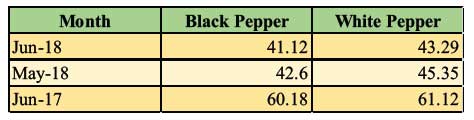
Note: The price index is calculated based on price developments during 2011-2015
Table 2:
Composite Price of Black and White Pepper in USD/MT
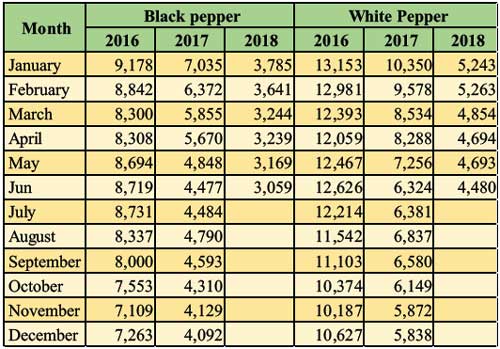
Pepper market continued to weak in June 2018. Local price of pepper in HCMC decreased to VND 55,000 per Kg for black and VND 92,500 for white pepper from VND 57,500 and VND 97,500 per Kg for black and white pepper respectively recorded at beginning of the month. On an average, black and white pepper price decreased by 5% and 3% respectively from the average price in May 2018.
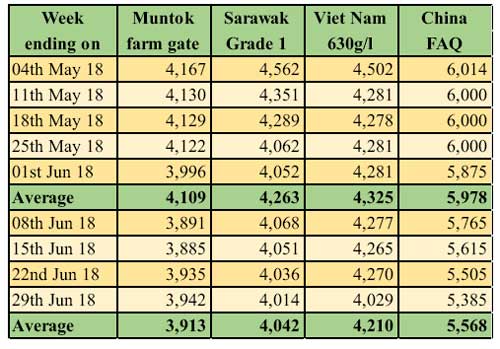
During June 2018, local price of Malabar black pepper price in Kochi decreased by INR 1.0 per Kg to INR 353 per Kg. When compared to average price in the previous month, the local price decreased marginally by 3%. In Lampung and Bangka the market was inactive, although initial harvest of pepper has started. Local price of black pepper in Lampung and Bangka has stood at the lowest level of IDR 35,000 and INR 55,000 per kg respectively for black and white pepper. When compared to average price in previous month, there was a decrease of IDR 2,500 per Kg.
In the last IPC Session, it was reported that production of pepper in Indonesia (Lampung and Bangka) increased this year. Some sources however reported that the increase may not as high as expected. Pepper harvest in Lampung has begun, but picking activity was not brisk since production of this year crop season is not encouraging. The increase may take place at non-traditional producing area such as Kalimantan and Sulawesi.
Observing the above situation, price of pepper in the second semester 2018 is expected to be not very volatile, since major share of pepper from Viet Nam has been released. Supply from Indonesia is likely not making significant pressure in the market.
Table 3:
Local Price of Black Pepper in US$ per Mt
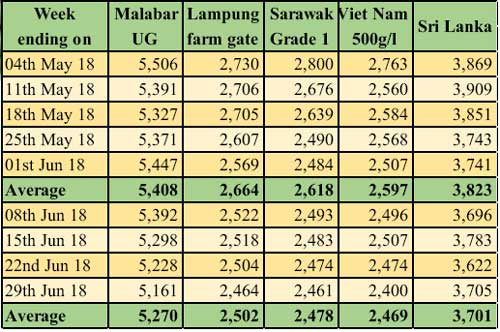
Table 4:
Local Prices of White Pepper in US$ per Mt
Highlight on current global market situation
Main issue of current low price
Pepper is widely known as the most significant spice. It is cultivated today in many tropical countries such as India, Indonesia, Malaysia, Sri Lanka, Viet Nam, China, Thailand, Cambodia, Madagascar, Brazil and Ecuador. In these countries, the cultivation of pepper plays an important role in the economy of small scale farmers in major pepper growing areas. In these countries around 90% of the production of pepper is contributed by the small scale farmers.
Pepper has an important place in the global trade of spices. Pepper is treated as the universal spice, because it was the first spice to be traded internationally and its dominance as a spice. Today it holds a significant position in world spice trade.
The world production of pepper always shows fluctuating trend for the last decades. Irrespective of the place/location/region of cultivation, the production of pepper depends on many factors like weather, incidents of diseases, quality of planting material, price etc. There are number of challenges faced by the pepper producers in different regions.
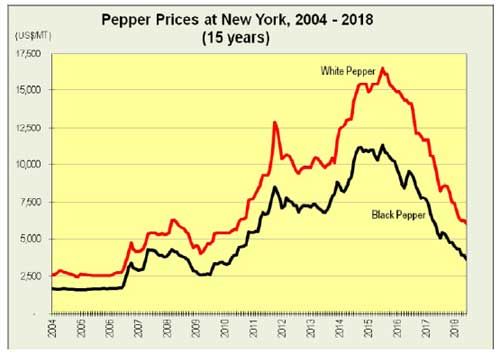
Today most concerned issue is drastic fall of price, after continuous price increase during the last decade (2006 - 2015). In New York spot price of black pepper increased from US$ 2,200 per Mt in 2016 to US$ 11,300 in mid-2015 while for white pepper increased to US$16,500 per Mt from US$ 3,860 in early 2006. Less than three years after the peak, the price has dropped significantly more than 50% to the level of US$ 3,640 per Mt for black and US$ 6,065 for white pepper recorded at the end of June 2018. Price in June 2018 is more or less same with price prevailed in early 2010. Main reason of the decrease is significant increase of supply in the last few years as a result of massive expansion of pepper area in almost all producing countries, particularly in Viet Nam, Brazil and Cambodia. Area expansion is also taken place in Indonesia, mainly in non traditional area, such as in Kalimantan and Sulawesi.
Spot price development in New York as shown below will illustrate price movement in the last 15 years.
Pepper Supply - Production
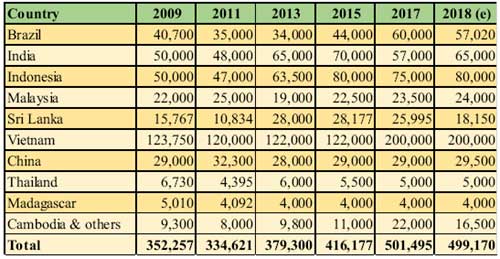
Last year (2017) production of pepper is reportedly to have touched 500.000 Mt. This production level was substantially higher when compared to production level in 2016 at 429,000 Mt, an increase of around 17% from the previous year and 40% from the average production during previous five years period of price increasing trend at 370,000 Mt in 2011-2015. This achievement was largely because of the substantial increase of pepper production in Viet Nam and Brazil. Today the share of Viet Nam in the world production of pepper is around 40% followed by Indonesia and Brazil (15% and 12% respectively). Most of their produce is exported owing to low domestic consumption.
The attractive price for pepper, which prevailed during 2011-2015 has encouraged pepper farmers to expand the area of pepper cultivation and also to maintain the existing crop in good condition. During this period, the production of pepper has increased in most of the producing countries like India, Indonesia, Sri Lanka and Malaysia. Significant increase has taken place in 2017, where production crossed 500,000 Mt, consisting of 396,000 Mt black and 105,000 Mt of white pepper. In 2018 the production is estimated to remain high. Although output from old plant decreases, but the increase of out-put from new plants will compensate the decrease from the old plants. The country wise world production pepper from the last ten years is given in the following table.
Table 5:
World Production of Pepper in Mt
World Export of Pepper
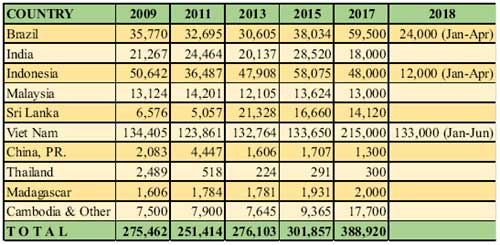
During period of price increasing trend (2011-2015) export of pepper is averagely at 270,000 Mt annually. In line with significant increase of production in the last few years, export of pepper in 2017 increased significantly to 390,000 mt, around 90,000 Mt (30%) increased from export in 2015 and 120.000 mt (40%) from average export during price increasing trend period (2011-2015). The steady increase in total world export of pepper is contributed mostly by the significant good export performance achieved by Viet Nam and Brazil.
In line with anticipated good production this year, export in 2018 is expected to remain high as indicated by export performance achieved by Viet Nam, Brazil and Indonesia in the last few months as shown below. Up to December 2018, total export is estimated to reach 385,000 Mt.
Table 6:
World Export of Pepper in Mt
Pepper is used in many ways today from a primary spice to applications in the preparation of traditional and modern medicines, nutraceuticals, perfumes, and other products. Pepper is also used in many different forms. Some of the value-added/processed products that have been developed include pepper oil, pepper oleoresin, green pepper in brine, dehydrated green pepper, and freeze dried pepper. Most of these products have helped to provide new value to pepper, by creating new uses, both in food and non-food applications.
The United States is the world's largest importer and consumer of pepper. The U.S. imports on average of 75,000-90,000 tons of pepper annually mainly from Brazil, India, Viet Nam and Indonesia. Germany and the Netherlands are also important pepper importing countries for both domestic consumption as well as processing/value addition and re-export. Presently India is also importing sizeable quantity of pepper which is mainly used for industrial purpose like processing/value addition and for re-export. Other major importing countries of pepper are the United Arab Emirates (UAE), Australia, Canada, Poland etc.
Considering demand increases year by year, while total production and export in 2018 is estimated to be more or less same as last year, price in the coming months is estimated to fluctuate in narrow range or flat at current level.
Previous Publications
- MARKET REVIEW - September 2019
- MARKET REVIEW - August 2019
- MARKET REVIEW - July 2019
- MARKET REVIEW - June 2019
- MARKET REVIEW - May 2019
- MARKET REVIEW - April 2019
- MARKET REVIEW - March 2019
- MARKET REVIEW - February 2019
- MARKET REVIEW - January 2019
- Market Review - December 2018
- Market Review - November 2018
- Market Review - October 2018
- Market Review - September 2018
- Market Review - August 2018
- Market Review - July 2018
- Market Review - June 2018
- Market Review - May 2018
- Market Review - April 2018
- Market Review - March 2018
- Market Review - February 2017
- Market Review - January 2017
- Market Review - December 2017
- Market Review - November 2017
- Market Review - October 2017
- Market Review - September 2017