
a UNESCAP Intergovermental Organization
a UNESCAP Intergovermental Organization
Monthly Publication
MARKET REVIEW - September 2019
PRICE HISTORY
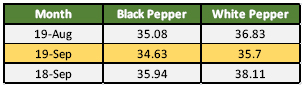
September 2019, price index continued to be reported negative. Losing 0.45 points price index of black pepper was reported with 1.3% drop when compared to the previous month at 34.63 (Table 1). However, when compared with the same period in 2018, price index of black pepper recorded a 4% loss. Price index of white pepper experienced a bigger drop with losing 1.13 points and was reported with 3.1% decrease as opposed to the previous month. Furthermore, when compared with the same period in 2018, price index of white pepper recorded a 6% loss.
Table 1. IPC Price Index (Base price: Average 2011-2015)
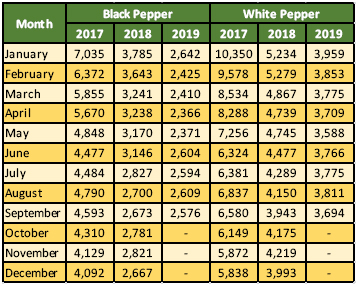
Composite price of black and white pepper for the 9th month of 2019 were reported with a deficit respectively. Losing USD 33 per Mt as opposed to the previous month, the composite price of black pepper was reported at USD 2,576 per Mt. September 2019 saw composite price of white pepper recorded a significant USD 117 per Mt deficit as opposed to July 2019 and was reported at USD 3,694 per Mt (Table 2). Recording the second biggest deficit of the year just behind USD 121 Per Mt loss on May 2019.
Table 2. Composite Price of Black and White Pepper (US$/Mt)
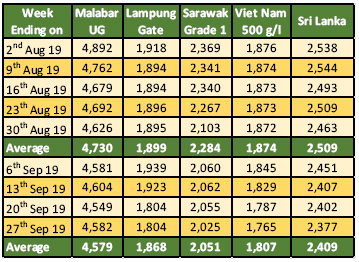
Pepper prices in 9th month of 2019, showed a negative outlook with Malaysia origin was reported with the biggest drop as opposed to the previous month. The farm gate of black pepper in India was reported at an average of USD 4,579 per Mt (Table 3). Thus, recording a 3% deficit when compared with August 2019. The decrease in price of black pepper in India could be contributed to large quantity of cheaper Sri Lanka pepper imports entering India at the MIP since August 2019. In a preliminary report released by Department of Commerce Govt. of India, India imported more than 800 Mt of whole pepper from Sri Lanka just in August 2019 alone.
The price of black pepper in Indonesia (Lampung black pepper) had also weakened when compared to August 2019. The farm gate price of Lampung black pepper for September 2019 was reported to be at an average of USD 1,868 per Mt, recording a decrease of USD 32 per Mt or 2% as compared to the previous month. As farmers in Lampung expecting significantly more yield this year following the favorable weather condition, market was flooded with abundance of stock which pushed down price in local currency to an average of IDR 26,190 per Kg.
The farm gate price of black pepper in Malaysia recorded a significant deficit. In September 2019, the farm gate price of black pepper in Malaysia was reported at an average of USD 2,051 per Mt which was the lowest ever in 2019, recording a deficit by 10% as compared to August 2019. The farm gate price of black pepper Malaysia in the local currency dropped to an average of MYR 8,566 per Kg from MYR 9,500 per Kg in August 2019 as the stock in local market quite steady following the end of harvest in mid-2019.
Farm gate price of black pepper in Viet Nam for September 2019 was reported to have decreased by 4% as opposed to previous month averaging at USD 1,807 per Mt. Furthermore, as result of the end of harvest period in Sri Lanka, September 2019 saw the farm gate price of black pepper in Sri Lanka also decreasing by 4% as opposed to the previous month and was reported at an average of USD 2,409 per Mt.
Table 3. Farm Gate Prices of Black Pepper (US$ per Mt)
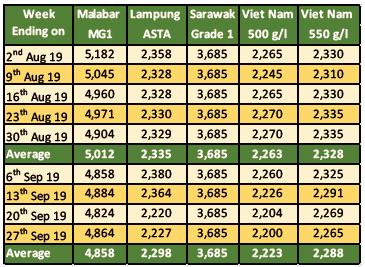
FOB price of black pepper was reported to have experienced similar response as farm gate prices (Table 4). The weakening of the price in the local currency, contributed to the large quantity of Sri Lankan pepper entering India, pushed down the FOB price of black pepper in India by 3% as compared with the previous month and was reported at an average of USD of 4,858 per Mt. Furthermore, the FOB price of black pepper in Indonesia was also reported to have decreased by 2% as opposed to previous month averaging at USD 2,298 per Mt. Contrary to the farm gate level, FOB price of Malaysian black pepper was reported stable at an average of USD 3,685 per Mt. Meanwhile, FOB price of Viet Nam black pepper 500 g/l and 550 g/l were reported with the same decrease of 2% as compared to the previous month with an average of USD 2,223 per Mt and USD 2,288 per Mt respectively.
Table 4. FOB Prices of Black Pepper (US$ per Mt)
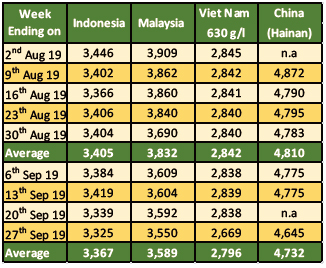
Farm gate prices of white pepper from all origins showed a negative outlook (Table 5) with Malaysia recording the highest deficit. As Indonesian harvest of Muntok white pepper came to full swing, Muntok white pepper was reported with a slight 1% decrease as compared to the previous month and was traded at an average of USD 3,367 per Mt. In local currency, the price of Muntok white pepper was reported at an average of IDR 47,452 per Kg. As result of the end of harvest period and steady stock, farm gate price of Malaysia white pepper was reported with a significant deficit of 6% as compared with the previous month and was traded at an average of USD 3,589 per Mt. Furthermore, Viet Nam white pepper was also reported with a deficit by 2% as opposed to the previous month at an average of USD 2,796 per Mt. Whilst, China white pepper was traded with a 2% deficit as opposed to the previous month at an average of USD 4,732 per Mt.
Table 5. Farm Gate Prices of White Pepper (US$ per Mt)
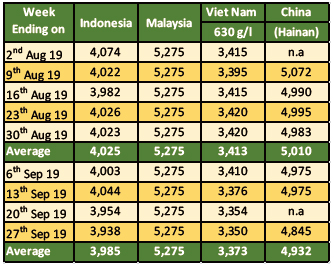
FOB price of white pepper also showed the same negative outlook with only Malaysia reported steady. FOB price of white pepper in Indonesia for September 2019 was reported with a slight deficit by 1% when compared to August 2019 and was reported at an average of USD 3,985 per Mt. Furthermore, FOB price of Malaysia white pepper was reported stable and unchanged. Whilst, Viet Nam FOB price of white pepper recorded a slight decrease of USD 41 per Mt or 1% as compared to the previous month averaging at USD 3,373 per Mt. FOB price of white pepper in China was reported with a deficit by 2% when compared to the previous month and was traded at an average of USD 4,932 per Mt (Table 6).
Table 6. FOB Prices of White Pepper (US$ per Mt)
HIGHLIGHT ON THAILAND
Production and Productivity
Thailand, officially the Kingdom of Thailand and formerly known as Siam, is a country at the centre of the Southeast Asian Indochinese peninsula. Agriculture in Thailand is highly competitive, diversified and specialized with a lucrative international trade. Rice is the country's most important crop, with around 60 % of Thailand's 13 million farmers growing it. Therefore Thailand had long been the world's leading exporter of rice. Thailand is also one of pepper producing country known to have cultivated its pepper partially in southern Thailand.
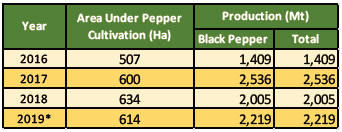
Since 2016, the area under pepper cultivation in Thailand had shown an increasing trend. As of May 2019, Thailand planted pepper on 614 Ha of area, recording an increase by 21% or 107 Ha of area when compared to 2016 (Table 7).
Furthermore, Thailand pepper production which mainly entirely black pepper, was reported fluctuated in the past 4 years with the highest yield reported to be in 2017, totalling at 2,536 Mt while the lowest yield was reported in 2016 with only 1,409 Mt. As of May 2019, production of pepper in Thailand shown an increasing trend with a total of 2,219 Mt which was an 11% increase when compared to the annual yield of 2018 and 57% increase compared to 2016.
Table 7. Area under Pepper Cultivation and Pepper Production
Source: Office of Agricultural Economics of Thailand
Pepper productivity in Thailand in the past 4 years was reported fluctuated. From 2016 until May 2019 pepper productivity in Thailand was reported with an increase by 30%. Furthermore, the highest pepper productivity in Thailand was reported in 2017 with 4,227 Kg per Ha. As of May 2019, pepper productivity in Thailand was reported with an increase by 14% as compared with the previous year at 3,614 Kg per Ha (Chart 1).
Chart 1. Pepper Productivity 2016-2019*
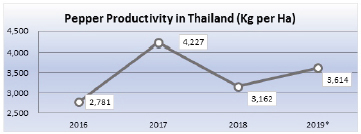
*Note: Productivity = Total production (Kg)/Area under pepper cultivation (Ha)
Pepper Export from Thailand
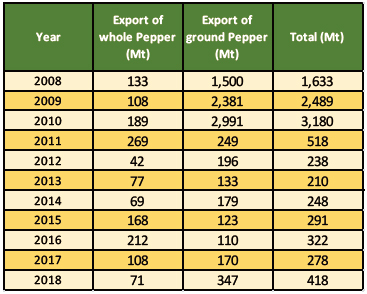
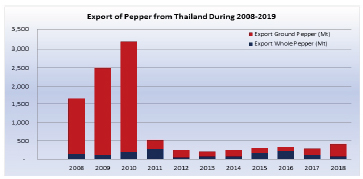
Thailand export of pepper was reported showing negative trend in the past 11 years and just started to slowly move up in the last year. Pepper export by Thailand during 2008 to 2018 was reported with an average of 30% whole pepper and 70% ground pepper (Chart 2). In the past 11 years, the highest quantity of pepper export by Thailand was reported on 2010 which reached 3,180 Mt while the lowest was reported on 2013 with 210 Mt (Table 8). Thailand pepper export from 2008 to 2018 had lost 1,215 Mt or 74%.
Year 2018 saw an increase in terms of pepper export by Thailand. Thailand was reported to have exported a total of 418 Mt which comprised of 71 Mt of whole pepper and 347 Mt of ground pepper. Thus, recording an increase of 50% or 140 Mt as compared with the previous year.
Table 8. Export of Pepper 2008 - 2018
Source: International Trade Centre (ITC) -
Geneva
Chart 2. Export of Pepper 2008-2018
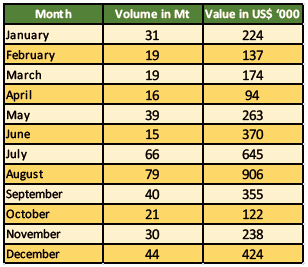
Pepper from Thailand both whole and ground is exported to various countries throughout the world. In 2018, Thailand was reported to have exported a total of 418 Mt. Thus, recording an average of 35 Mt per month. The total revenue of Thailand export in 2018 was reported to be as high as USD 3.9 Million. In 2018, the largest exports occurred in August which reached 79 Mt (Table 9).
Furthermore, in 2018, Thailand's top 5 country destinations for both their whole and ground pepper were reported to be South Africa with 130 Mt (approximately 32% of the total pepper export by Thailand), United States of America with 73 Mt (18%), Australia with 24 Mt (6%), Viet Nam with 22 Mt (5%) and Netherland with 21 Mt (5%).
Table 9. Export Quantity and Value of Pepper from Thailand in 2018
Source: International Trade Center - Geneva
Pepper Price
The farm gate price of pepper in Thailand slipped down significantly in the past three years which could be attributed to the world supply of pepper which significantly exceeded the global demand.
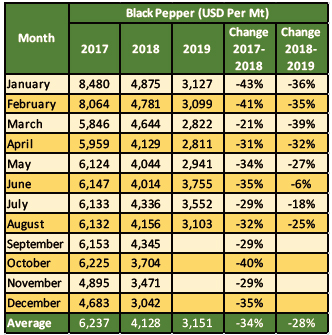
In 2017, the highest average price of Thailand black pepper was reported to have reached USD 8,480 per Mt (Jan 2017), whereas in 2018 the highest average price was only USD 4,875 per Mt (Jan 2018), recording a 43% decrease as compared to the year 2017. In 2018, the average farm gate price of black pepper in Thailand was reported at USD 4,128 per Mt, recording a decrease of 34% as compared to the average price in 2017.
As of August 2019, the farm gate prices of Thailand black pepper fluctuated with the average farm gate price of black pepper was reported at USD 3,151 per Mt, recording a decrease of 28% as compared to the same period in 2018. As of August 2019, the highest average price of Thailand black pepper was reported in June with USD 3,755 per Mt (Table 10).
Table 10. Monthly Average Farm Gate Prices of Black Pepper in Thailand
Source: Office of Agricultural Economics of Thailand
Source:
- Brazil, Unofficial source (Coreimex, CSG Trade)
- India: AISEF, NCDEX, Indian Chamber of Commerce & Industry
- Indonesia: Unofficial source
- Malaysia: Malaysian Pepper Board
- Sri Lanka: Department of Export Agriculture
- Viet Nam : Viet Nam Pepper Association, HCMC
- China: Hainan Pepper Association, China Spice Association
- A.A. SAYIA & Company
- International Trade Centre (ITC) - Geneva
Note: Some of the data in this publication are from the IPC database. The data are obtained from official reports and correspondence between the IPC and Sri Lanka and have been processed based on statistical norms that can be accounted for.
Previous Publications
- MARKET REVIEW - September 2019
- MARKET REVIEW - August 2019
- MARKET REVIEW - July 2019
- MARKET REVIEW - June 2019
- MARKET REVIEW - May 2019
- MARKET REVIEW - April 2019
- MARKET REVIEW - March 2019
- MARKET REVIEW - February 2019
- MARKET REVIEW - January 2019
- Market Review - December 2018
- Market Review - November 2018
- Market Review - October 2018
- Market Review - September 2018
- Market Review - August 2018
- Market Review - July 2018
- Market Review - June 2018
- Market Review - May 2018
- Market Review - April 2018
- Market Review - March 2018
- Market Review - February 2017
- Market Review - January 2017
- Market Review - December 2017
- Market Review - November 2017
- Market Review - October 2017
- Market Review - September 2017