a UNESCAP Intergovermental Organization
a UNESCAP Intergovermental Organization
Monthly Publication
Market Review - May 2018
General
Pepper market in May remained weak and price of black pepper decreased further, particularly in Sarawak, Malaysia and Kochi, India while price of white pepper, except in Sarawak was relatively stable. Significant decrease in Sarawak was likely due to their picking in May was on full swing.
In the beginning of May 2018, pepper price in Viet Nam increased to the level of VND 63,000 per Kg for black and 102,500 for white pepper from VND 54,300 and VND 92,500 per Kg respectively for black and white pepper in early April 2018. During May however, the price then decreased to VND 56,700 and VND 97,500 per Kg for black and white pepper respectively toward month end. On an average the price of pepper in Viet Nam was more or less the same with average price prevailed in April 2018 to remains close to VND 60,000 per kg. Noticeably, this is the lowest price in the last decade which was similarly seen in 2008. In the first 5 months, it is estimated that Viet Nam exported about 115,000 Mt mainly went to China and the US. The relatively stable price in Viet Nam was due to producer continued to hold material and only release small portion, while expecting better price in near future. In addition to that, small farmers have less stock while the big ones carry it. In Indonesia, price of black and white pepper was relatively stable with very limited activity.
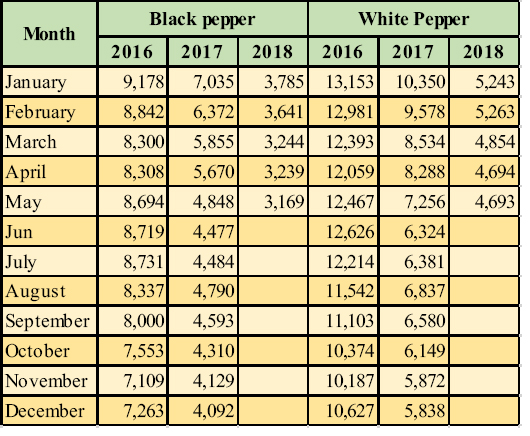
Overall, pepper price index in May 2018 decreased by 0.94 points for black while it was stable for white (Table 1). The composite price of black pepper decreased 2.2% to US$ 3,170 per Mt from US$ 3,240 in April 2018. Composite price of white pepper was unchanged at the level of US$ 4,690 per Mt. (Table 2).
Table 1. IPC Price Index in US$/Mt (Base Year: Average 2011 - 2015)
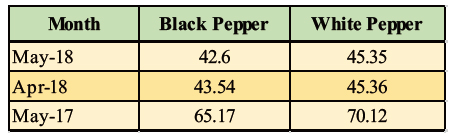
Note: The price index is calculated based on price developments during 2011-2015
Table 2: Composite Price of Black and White Pepper in US$/Mt
Highlight on Sri Lankan Pepper
Area and Production
In Sri Lanka pepper is generally grown in almost all districts but it thrives well in wet and intermediate agro-ecological zones up to the elevation of about 800 meters above mean sea level. Main pepper growing areas are in Central, North Western, Sabaragamuwa, Southern and Uva province. In Central Province pepper is planted in Kandy and Matale districts. Pepper area also spreads in Kurunegala district in North Western province; Badulla, Monaragala district in Uva province; Kegalle, Raatnapura district in Sabaragamuwa province. In Galle, Matara districts and a part of Hambantota district in Southern province the pepper cultivations are also prominent. Distribution of pepper cultivation Provincial wise in Sri Lanka from the year of 2015 to 2017 is given below.
Table 3. Distribution of pepper area in Sri Lanka
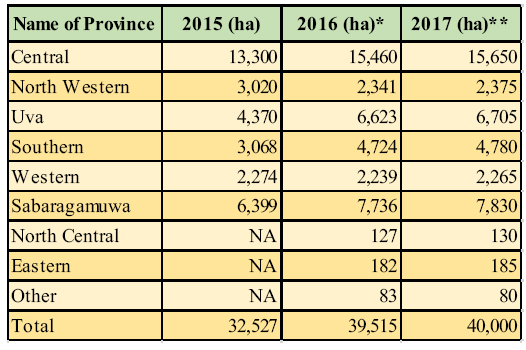
Note: * revised figure based on Department of Census and Statistics ** estimate
Approximately 60%-70% of pepper cultivations in Sri Lanka are small scale (less than one acre), mainly as home gardens or mixed cropping system. Only a few large scales cultivations (above 20ha) exist in the country. Since pepper is mainly grown by small holders, their investments on commercial production and processing practices are very low and irregular. Therefore, the average productivity of pepper in many pepper holdings in Sri Lanka is well below the potential.
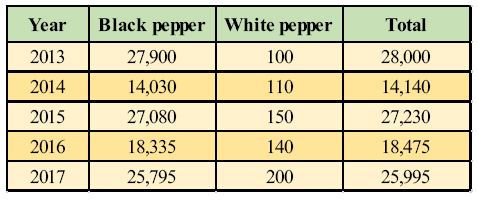
Production of pepper in Sri Lanka changes sharply year by year because of weather factor. In the last five years, production moved up and down in the range of 14,000-28,000 Mt, as shown in the following table.
Table 4. Production of pepper in Sri Lanka 2013 -2017 in Mt
Export and Import
Sri Lanka process pepper in various types of commodity such as whole pepper including raw material as well as in the form of crushed or ground pepper. The major form of whole pepper produced in Sri Lanka is black pepper which contributes to more than 90% of the total pepper production as well as the exports. White pepper fetches high price even at local market, but production of white pepper is relatively low due to preparation difficulties. Other main value-added forms of pepper produced in Sri Lanka are crushed and ground peppers, pepper oil and oleoresin. Exports of pepper oil and oleoresin have increased significantly in past three years due to a large processing facility established under a foreign investment. Sri Lanka also produces value-added products such as dehydrated pepper and pepper in brine etc. but in very small quantities.
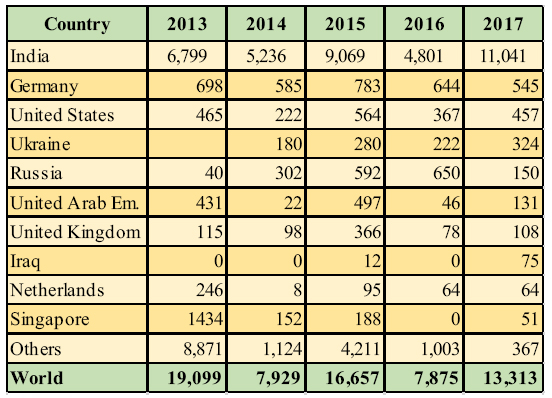
In line with production development, export of pepper from Sri Lanka is up and down sharply in the range of 5,000 - 20,000 Mt, with alternating hoses every two years, as shown in the following table and chart. Export of ground pepper in the last four years was relatively stable at around 1,000 Mt. In 2017, pepper export from Sri Lanka increased to 13,300 Mt from 7,900 Mt in 2016. Export of whole pepper increased, while for ground pepper decreased. India is the main market for Sri Lankan pepper absorbing around 80-90% of pepper exported from the country; while for ground pepper was mainly exported to Eastern Europe.
Table 5. Export of pepper by Sri Lanka during 2008 - 2017
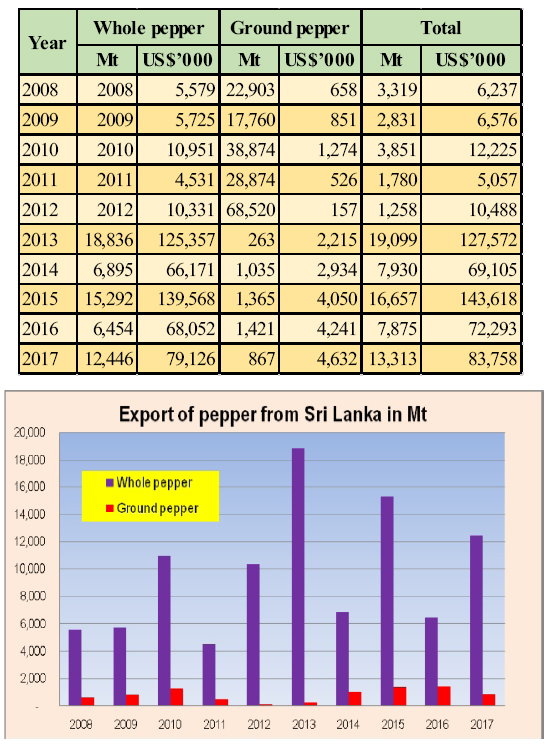
Table 6. Export of pepper from Sri Lanka to top ten country of destination
Beside whole and ground pepper, Sri Lanka also exports pepper oil and oleoresin. A volume of around 40-60 Mt of pepper oil and 300-500 Mt of pepper oleoresin was exported in the past years mainly shipped to India.
In the last few years, Sri Lanka also imported significant quantity of pepper mainly from Viet Nam. According to Vietnam's statistics, a volume of 3,400 Mt of Vietnamese pepper was shipped to Sri Lanka in 2017 compared to 450 Mt in 2016. Some source reported that pepper imported from Viet Nam was re-exported to India for industrial use.
The last IPC session held in Kandy, Sri Lanka in November 2017 reported that Production of pepper in Sri Lanka will decrease significantly from 26,000 Mt to 18,000 Mt in 2018. Main reason was due to unfavorable weather during flowering and fruiting stages. Consequently, export of pepper this year is estimated to decrease. However, since available good stock carried from last year, the decrease of export in 2018 is anticipated to be not significant. During January - March 2018, Sri Lanka exported around 2,500 Mt of pepper which was higher than the export in the same period last year.
Price
Sri Lankan pepper is mostly marketed to India. Hence, market development in India by and large will influence pepper market in Sri Lanka. Pepper price in Sri Lanka was recorded from some growing areas, such as in Kandy, Matale, Kurunegala, Badulla, Monaragala, Kegalle, Ratnapura,Galle and Matara.
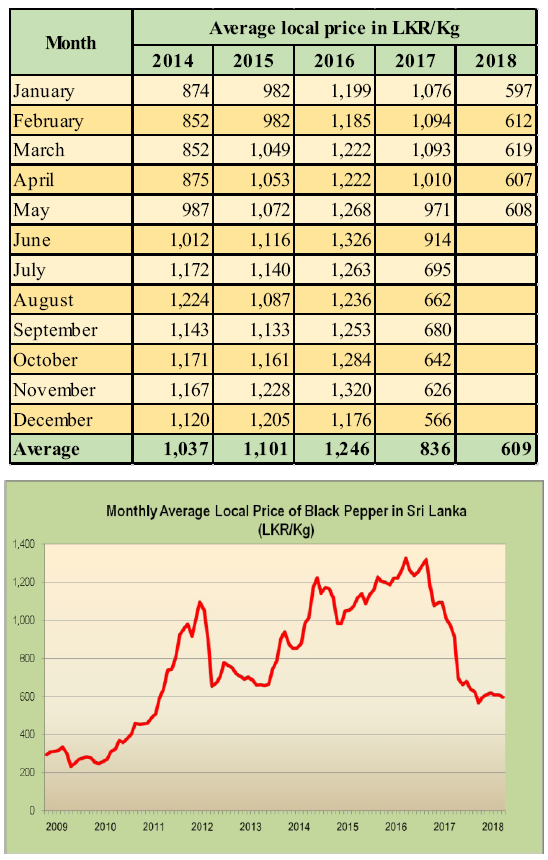
During the month of May 2018 average price of pepper at these growing areas decreased from LKR 616 per Kg to LKR 596 at the month's close. On an average pepper price in May was LKR 608 per Kg. When compared to average price in May 2017, the price decreased by 37%. The average price in May 2018 was 54% lower from the highest achieved in June 2016.
In the second half of the year pepper price is expected to be not further decrease, since total production of this year is anticipated to be significantly lower.
The following table and chart will clearly illustrate the development.
Table 7. Monthly average price of pepper in Sri Lanka 2014 - 2018
Previous Publications
- Market Review - August 2017
- Market Review - July 2017
- Market Review - June 2017
- Market Review - May 2017
- "Market Review - April 2017 "
- Market Review - March 2017
- Market Review - February 2017
- Market Review - January 2017
- Market Review - December 2016
- Market Review - November 2016
- Market Review - October 2016
- Market Review - September 2016
- Market Review - August 2016
- Market Review - July 2016
- Market Review - June 2016
- Market Review - May 2016
- Market Review - April 2016
- Market Review - March 2016
- Market Review - February 2016
- Market Review - January 2016
- Market Review - December 2015
- Market Review - November 2015
- Market Review - October 2015
- Market Review - September 2015
- Market Review - August 2015