
a UNESCAP Intergovermental Organization
a UNESCAP Intergovermental Organization
Monthly Publication
MARKET REVIEW - January 2019
PRICE HISTORY
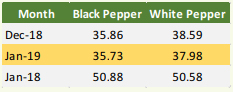
At the beginning of 2019, the IPC index prices of black and white pepper were reported to continue to decline. In January 2019, the index price of black pepper was reported at 35.73, experiencing a decline of 0.13 points compared to December 2018. The index price of white pepper also reportedly continued to decline since 2017 until now. In January 2019, the index price of white pepper experienced a decline of 0.61 points compared to December 2018 (Table 1). Furthermore, the index prices for black and white pepper reported 30% and 25% decline respectively when compared to the same period in the beginning of 2018.
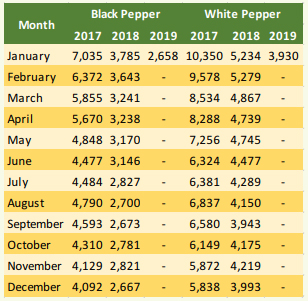
Since 2017 until the beginning of 2019, the composite price of black pepper and white pepper has been reported declining. The Composite price of black pepper in January 2019 was reported at US$ 2,658 per Mt. When compared with the beginning of 2018, the composite price of black pepper in 2019 declined by 30% and experienced a US$ 1,127 per Mt loss. Furthermore, the composite price of white pepper in January 2019 was reported at US$ 3,930 per Mt, a decline of 25% or a loss of US$ 1,304 per Mt when compared to the composite price in January 2018 (Table 2). The decline in the composite price was due to the substantially high quantity of the global pepper stocks. Year by year, pepper production has been reported to significantly increase in most countries yet the demand of the pepper global consumption has only shown a marginal increase. The overflowing stocks pushes the price to keep declining.
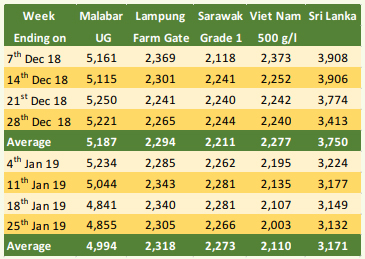
At the beginning of 2019, pepper prices in several producing countries showed mixed responses (Table 3). The average of the farm gate prices of black pepper in India in January 2019 was reported to be US$ 4,994 per Mt. When compared with the average price in December 2018 with a value of US$ 5,187 per Mt, the average price in January 2019 recorded a decrease of 4%. The decline in the price of black pepper in India is caused by the illegal entry of cheap black pepper to India through the borders of countries near India.
The price of black pepper in Indonesia (Lampung Black Pepper) at the beginning of 2019 experienced a slight increase compared to the end of 2018. The average of the farm gate prices of black pepper in Lampung in January 2019 was reported to be US$ 2,318 per Mt, an increase of US$ 24 per Mt or 1% compared to the end of 2018. The depletion of black pepper from pepper producing-countries such as Viet Nam and India has caused black pepper demand to increase slightly in Indonesia. Limited stock of black pepper and increasing demand has led to an increase in pepper prices in Lampung.
The average of the farm gate prices of black pepper in Malaysia reported a slight increase (not significant). Based on local currency, black pepper prices in Malaysia are reported to be stable / no change. The increase in prices in dollar terms was due to the strengthening of Malaysia's local currency against the US Dollar. At the end of January 2019, the average of farm gate prices for black pepper from Malaysia were reported at US$ 2,273 per Mt, recording a 3% increase compared to prices at the end of December 2018 with a value of US$ 2,211 per Mt.
Average farm-gate price of black pepper in Viet Nam reported a significant decline. At the end of January 2019, the average farm gate price of black pepper in Viet Nam was reported to be US$ 2,110 per Mt, a decrease of US$ 167 per Mt or a 7% decrease compared to the end of December 2018 with a value of US$ 2,277 per Mt. Declining prices in Viet Nam due to the end of January 2019 Viet Nam faced a fairly good harvest season. In the near future the stock of pepper in Viet Nam will increase which might pressure the price.
Furthermore, the average farm gate price in Sri Lanka decreased considerably. In January 2019, the average farm gate prices of black pepper in Sri Lanka was reported at US$ 3,171 per Mt which was a declined of 15% compared to the average price in December 2018. The decline in prices in Sri Lanka was caused by various factors, one of which was the unstable political situation in Sri Lanka which had caused the weakening of Sri Lanka's local currency against the US Dollar.
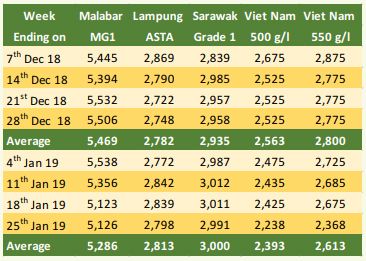
FOB prices of black pepper were reported to have experienced the same trend as farm gate prices of black pepper. In January 2019, the FOB price of black pepper in India was reported to have declined by 3% compared to FOB price in December 2018. The decline in FOB prices also occurred in black pepper from Viet Nam. Black pepper with a quality of 500 g/l and 550 g/l were reported to have declined in price by 7%. Declining FOB prices in India and Viet Nam is the effect of weakening farm gate prices caused by illegal entry of pepper into India and response to nearing the harvest season in Viet Nam. Furthermore, the FOB price of black pepper in Indonesia and Malaysia is reported to increase by 1% and 2% respectively which both of them could be contributed to the strengthening of their local currencies towards US dollar (Table 4).
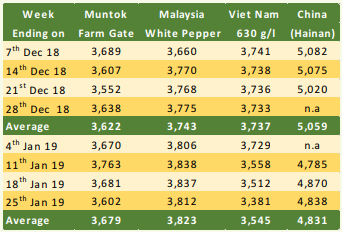
Farm gate prices of white pepper in Indonesia and Malaysia experienced an increasing trend, but in Viet Nam and the China farm gate prices of white pepper experienced a decline (Table 5). The increase in farm gate prices of white pepper in Indonesia from US$ 3,622 per Mt to US$ 3,679 per Mt was due to the strengthening of Indonesia's local currency against the US Dollar. In local currency, the price of Muntok White Pepper was reported to be stable at IDR 51,000 - IDR 53,000 per Kg. As in Indonesia, the increase in farm gate prices in Malaysia was due to the strengthening of Malaysia's local currency against the US Dollar. Farm gate prices of white pepper was reported to be stable at RM 15.7 per Kg.
In Viet Nam, the average farm gate price of white pepper was reported to have declined by 5% from US$ 3,737 per Mt to US$ 3,545 per Mt. Similar to black pepper, the decline in the price of white pepper in Viet Nam was also caused by the near harvest time so that the availability of pepper predicted to increase quite sharply. Furthermore, the farm gate price of white pepper in China also declined of up to 5% from US$ 5,059 per Mt to US$ 4,831 per Mt. The decline in prices in China was caused by the insignificant demand for white pepper from China which caused buyers and traders to take a wait and see attitude.
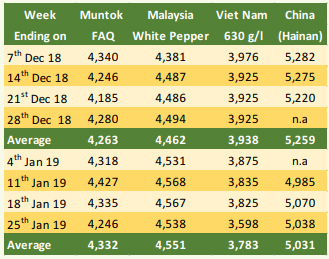
FOB prices of white pepper followed the same trend as farm gate prices of white pepper. FOB prices in Indonesia and Malaysia in January 2019 increased with a 2% margin respectively when compared to December 2018. Meanwhile in Viet Nam and China it decreased by 4 % respectively and were traded at an average of US$ 3,783 and US$ 5,031 respectively (Table 6).
HIGHLIGHT ON VIETNAM
Production and Productivity
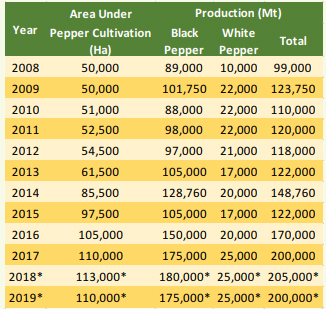
Viet Nam is known as the largest pepper producing country in the world with pepper cultivation areas in Central Highland (Gia Lai, Dak Lak, and Dak Nong provinces) and Southern East areas (Dong Nai, Binh Puoc, and Ba Ria - Vung Tau provinces). Since 2012 - 2017 the pepper expansion area in Viet Nam had increased very rapidly. This happened due to the skyrocketing price of pepper at that moment. In 2008, Viet Nam only had 50,000 ha of pepper planting area, whereas in 2018 Viet Nam planted pepper on a 113,000 ha area, recording a 126% increase over 10 years (Table 7). Uncontrolled expansion area has led to a significant growth in production that goes far beyond demand. The implication of this is that the pepper industry faces a serious problem of low price which will likely to continue in the next few years, unless there is genuine strategy from all stakeholders to cut down the overflowing stocks and increase both domestic and global consumption.
In 2018 pepper production in Viet Nam was estimated to reach 205,000 Mt consisting of 180,000 Mt black pepper and 25,000 Mt white pepper (Table 7). Although the production of old plant had been reduced and unfavourable weather conditions in flowering season 2018, the decline however had been compensated for by the increased output from new pepper plants. Under the situation of unfavourable price of pepper, the increased production is not enough to meet the increasing cost of picking. As a result, many farmers with less productive plants are likely to convert the plants to other crops.
*Note: Figures are estimate, subject to revision
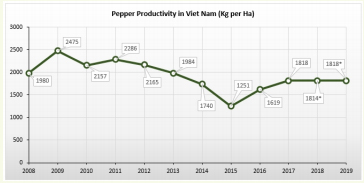
Pepper productivity in Viet Nam from 2009 to 2015 showed a declining trend. In 2009 pepper productivity in Viet Nam reached 2,475 Kg per Ha, while in 2015 there was a decrease of 49% to 1,251 Kg per Ha. Decreased productivity was influenced by many factors, such as unfavourable weather and the emergence of pests and diseases. To increase pepper productivity again, farmers in Viet Nam are known to use synthetic chemical pesticides to avoid pest and disease attacks. This effort had yielded quite good results, pepper productivity in Viet Nam in 2017 increased by 45% compared to 2015. Nevertheless, despite increasing productivity, Viet Nam faced a new challenge, namely pesticide residues.
The impact of the efforts to avoid new land clearing in Viet Nam is a slight decrease in pepper production in Viet Nam in 2019. It is predicted that in 2019 the area planted with pepper in Viet Nam will be 110,000 ha with a total production of 200,000 Mt consisting of 175,000 Mt black pepper and 25,000 Mt white pepper.
The Viet Nam Government recently issued a policy to ban the opening of new pepper gardens in Viet Nam. This policy aims to reduce the amount of pepper production in Viet Nam which is currently very high. Farmers are advised to take care of the existing gardens by implementing Good Agricultural Practices (GAP) and Integrated Pest Management (IPM). The Viet Nam government continues to emphasize to farmers that the most important thing that farmers must do now is to ensure that the pepper they produce has a high quality.
One of Viet Nam's biggest challenges today is the presence of pesticide residues in their pepper products, so that pepper from Viet Nam is difficult to penetrate the international market. Viet Nam will begin to reduce the use of synthetic chemical pesticides and start developing organic gardens. This effort is expected to be one of the solutions to improve pepper quality in Viet Nam, and would be able to maintain the stability of pepper prices in Viet Nam.
Through intensive agricultural practices pepper farmers in Viet Nam achieved very high productivity and placed Viet Nam as the top pepper producing country in the world. However, after years of being at the top, the priorities are now shifting more on how to produce pepper without significant pesticide residues, how to make pepper farming more sustainable, how to maintain soil health, how to reach out to customers, etc. Those concerns are still not yet solved and delivered significant outcomes, farmer not widely followed and applied nation wide in their cultivation practices.
It’s suggested that now its the right time for Viet Nam to focus on quality strategy which increases more organic pepper and cultivates in a more sustainable way. There is excellent multiple cropping system in practice in other IPC members countries would be a good reference for Viet Nam to learn. This would bring both crop as well as financial sustainability. Another area is to utilise post harvest technologies which also need to be further explored with support and cooperation from private sector.
*Note: Figures are estimate, subject to revision
Pepper Export from Viet Nam
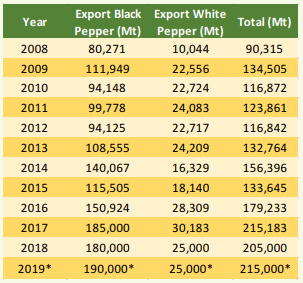
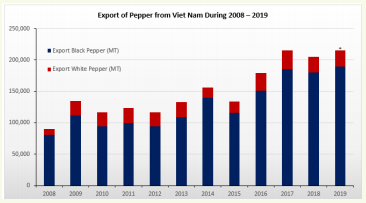
Most of the pepper products in Viet Nam are exported to various countries. Since 2008 until 2018 there had been a 127% increase in the number of exports from Viet Nam. Compared to 2017, pepper exports from Viet Nam in 2018 decreased by 5% from 2017 (Table 8).
*Note: Figures are estimate, subject to revision
Pepper from Viet Nam is exported to various countries in Asia, America, Europe and Australia. In 2018, pepper exports from Viet Nam were able to meet 25% of the total imported pepper by the Netherlands, 28% of the total imports by Germany, and 35% of the total imports of the USA.
*Note: Figures are estimate, subject to revision
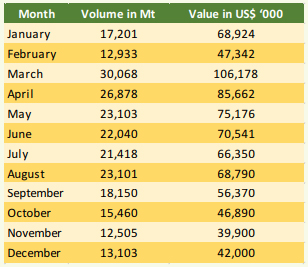
The number of pepper exports from Viet Nam has reportedly fluctuated from 2008 to the present. Even so, the export trend of Viet Nam is known to increase. In 2018 the average pepper export from Viet Nam was 19,663 Mt per month with an average value of US$ 64.5 million per month. In 2018 the largest exports occurred in March, April and May with quantities reaching 30 KMt, 26.8 KMt, and 23 KMt respectively. Exports from Viet Nam increased in quantity again in August (23 KMt) (Table 9). The high level of exports during the month was due to Viet Nam just experienced a harvest season so that the stock of pepper was quite high.
In 2019, Viet Nam's exports are predicted to increase by 5% compared to total exports in 2018. Although Viet Nam's production is predicted to experience a slight decline, Viet Nam's stock carry over is still quite high (35,861 Mt), thus, allowing big exports.
Source: International Trade Center - Geneva
Pepper Price
The price of pepper in Viet Nam slipped down significantly. In addition to the quality factor, the main reason for the fall in prices was the offer which exceed demand.
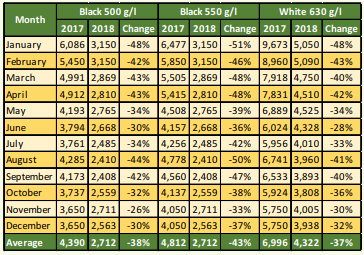
In 2018 the average price of Viet Nam black pepper (500 g / l) was reported at US$ 2,712 per Mt, experienced a decrease of 38% compared to the average price in 2017. In 2017 the highest price of Viet Nam black pepper (500 g / l) was reported to have reached US$ 6,086 per Mt, whereas in 2018 the highest average price was only US$ 3,150 per Mt, or experienced a 48% decrease compared to the year 2017. Furthermore, Viet Nam black pepper (550 g / l) also reported a significant decline with an average price decline of 43%. In 2017 the average price of Viet Nam black pepper (550 g / l) was reported to reach US$ 4,812 per Mt, while in 2018 it was reported to have decreased to US$ 2,712 per Mt. The same thing also happened to Viet Nam white pepper which decreased from US$ 6,996 per Mt to US$ 4, 322 per Mt (Table 10).
Various efforts were made by the Viet Nam government to increase pepper prices again. Some farmers in Viet Nam complain that the selling price of pepper is not far from the price of production. One of the efforts made to overcome this issue is not to open new plantations in 2019 so as not to over-produce. Another effort is to build organic pepper plantations. Organic products are known to have their own markets and have better prices compared to conventionally cultivated agricultural products. Besides organic pepper cultivation can also reduce production costs such as for the purchase of synthetic chemical pesticides.
Source: International Trade Center - Geneva
Source:
- Brazil, Unofficial source (Coreimex, CSG Trade)
- India: AISEF, NCDEX, Indian Chamber of Commerce & Industry
- Indonesia: Unofficial source
- Malaysia: Malaysian Pepper Board
- Sri Lanka: Department of Export Agriculture
- Viet Nam : Viet Nam Pepper Association, HCMC
- China: Hainan Pepper Association, China Spice Association
- A.A. SAYIA & Company
- International Trade Centre (ITC) - Geneva
Note: Some of the data in this publication are from the IPC database. The data are obtained from official reports and correspondence between the IPC and the Viet Nam government, the Viet Nam Pepper Association, and have been processed based on statistical norms that can be accounted for.
Previous Publications
- Market Review - August 2017
- Market Review - July 2017
- Market Review - June 2017
- Market Review - May 2017
- "Market Review - April 2017 "
- Market Review - March 2017
- Market Review - February 2017
- Market Review - January 2017
- Market Review - December 2016
- Market Review - November 2016
- Market Review - October 2016
- Market Review - September 2016
- Market Review - August 2016
- Market Review - July 2016
- Market Review - June 2016
- Market Review - May 2016
- Market Review - April 2016
- Market Review - March 2016
- Market Review - February 2016
- Market Review - January 2016
- Market Review - December 2015
- Market Review - November 2015
- Market Review - October 2015
- Market Review - September 2015
- Market Review - August 2015