
a UNESCAP Intergovermental Organization
a UNESCAP Intergovermental Organization
Monthly Publication
MARKET REVIEW - MAY 2020
PRICE HISTORY
Price index of pepper for the month of May 2020 was reported with a positive outlook. Recording a rather significant increase by 2.31 points when compared with the previous month, price index of black pepper was reported with a spike of 8% at 31.29. In addition, when compared with the same period in 2019 the price index of black pepper recorded a slight 2% drop. Continuing the positive trend, the price index of white pepper was reported with a significant spike by 6.9% when compared with the previous month at 32.40 (Table 1). However, when compared with May 2019, the price index of white pepper was reported with a 7% loss.

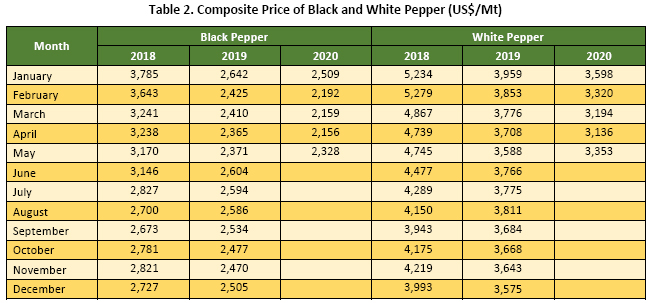
As the global pandemic of Corona Virus continued on, the 5th month of 2020 showed a rather positive outlook for the composite prices of pepper. The composite price of black pepper recorded a hefty increase by USD 172 per Mt as compared with the previous month and was reported at USD 2,328 per Mt. Along the line with the composite price of black pepper, the composite price of white pepper also recorded an increase with USD 3,353 per Mt, a spike of USD 217 per Mt was reported as compared with the previous month.
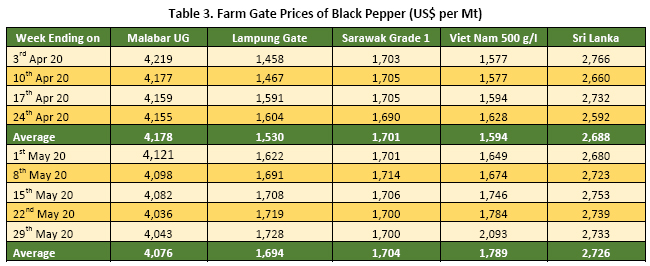
Pepper prices in the 5th month of 2020, showed a mixed response with a rather positive outlook as only India and China origin were reported with a decreased. The farm gate price of black pepper in India was reported with 2% deficit as opposed to April, averaging at USD 4,076 per Mt (Table 3). In the local currency farm gate price of India black pepper was traded at an average of INR 307 per Kg which was a decreased from INR 316 per Kg in the previous month. The decrease of India black pepper could be contributed to the subdued demand of pepper during the lockdown period as only limited activity occurred in the local market while the arrival of new pepper at the terminal market was halted due to the absence of local transport.
https://www.thehindubusinessline.com/markets/commodities/subdued-demand-for-pepper/article31594695.ece
The price of black pepper in Indonesia (Lampung black pepper) was reported with a significant increase of 11% as opposed to the previous month, averaging at USD 1,694 per Mt. The increase of Indonesia black pepper could be contributed to the increase of demand while the stock was limited. Another contributing factor was the strengthening of Indonesia's local currency against the US Dollar (IDR 14,906 for USD 1) or an appreciation by 6% when compared to April. In local currency, the price of Indonesia black pepper increased to an average of IDR 25,500 per Kg from IDR 24,667 per Kg in April.
As Malaysia entered harvest season, the farm gate price of Malaysia's black pepper for the 5th month of 2020 was reported stable and averaging at USD 1,704 per Mt. In local currency, the price of Malaysia black pepper was reported stable and unchanged.
Furthermore, farm gate price of black pepper in Viet Nam was reported with a significant increased by 12% as compared to the previous month, averaging at USD 1,789 per Mt. The increase of Viet Nam price could be contributed to the significant increase of demand. In local currency, the price of Viet Nam black pepper increased to an average of VND 43,150 per Kg from VND 37,881 per Kg in April.
Entering the harvest season, the farm gate price of Sri Lankan black pepper was reported with an increase of 1% as opposed to April and was reported at an average of USD 2,726 per Mt. The increase of Sri Lanka black pepper could be contributed to the strengthening of Sri Lanka's local currency against the US Dollar (LKR 187.87 for USD 1) or an appreciation by 3% when compared to April. In local currency, the price of Sri Lanka black pepper decreased to an average of LKR 514.58 per Kg from LKR 516.83 per Kg in April.
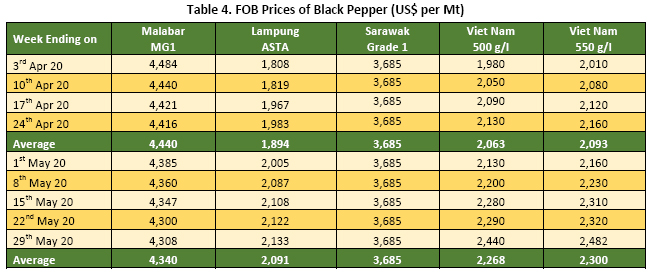
FOB price of black pepper for May 2020 followed the farm gate price trend as only India origin was reported with a decrease. India traded its Malabar black pepper internationally with the same decrease by 2% when compared to April, averaging at USD 4,340 per Mt (Table 4). Furthermore, the FOB price of Indonesian black pepper was reported with significant increase of 10% as opposed to April, averaging at USD 2,091 per Mt. FOB price of Malaysian black pepper was reported stable at an average of USD 3,685 per Mt. FOB price of Viet Nam black pepper 500 g/l and 550 g/l were reported with an increase of 10% respectively as compared to the previous month averaging at USD 2,268 per Mt and USD 2,300 per Mt respectively.
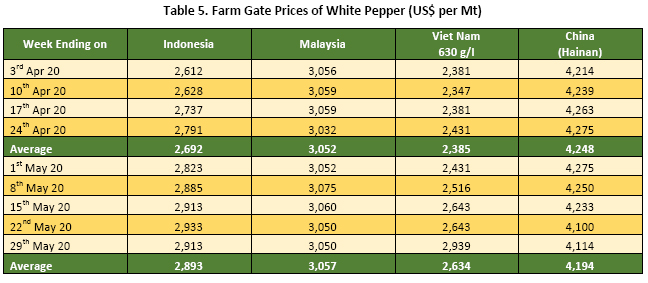
Farm gate prices of white pepper in May 2020 showed a mix response with a rather positive outlook (Table 5) as only China origin was reported with a decrease. Indonesia Muntok white pepper was reported with a significant increase of 7% as compared to the previous month at an average of USD 2,893 per Mt. In local currency, the price of Muntok white pepper was reported at an average of IDR 43,375 per Kg, a slight increase of IDR 161 per Kg when compared with the previous month. Similar to black pepper, the increase of Indonesia white pepper could be contributed to the increase of demand while the stock was limited as well as the strengthening of Indonesia's local currency against the US Dollar. Farm gate price of Malaysia white pepper was reported steady at an average of USD 3,057 per Mt. Furthermore, Viet Nam white pepper was reported with a significant increase of 10% when compared to the previous month, averaging at USD 2,634 per Mt. Contrary to other origins, China white pepper was reported with a decrease by 1% as opposed to the previous month and was traded at an average of USD 4,194 per Mt locally.
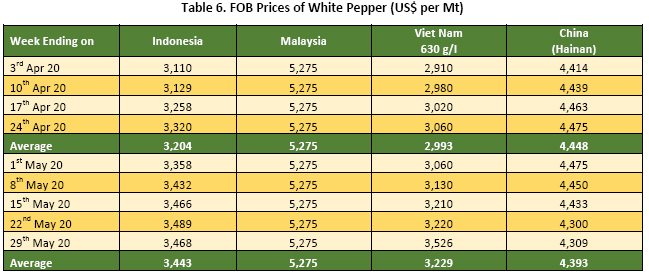
FOB price of white pepper also showed a mix response with a rather positive outlook as only China origin was reported with a decrease. Continuing the trend of the farm gate price, FOB price of Indonesia white pepper for May 2020 was reported with a significant increase of 7% when compared to April, averaging at USD 3,443 per Mt. Furthermore, FOB price of Malaysia white pepper continued to be reported stable and unchanged. Following the surge of demand for white pepper especially from China upon the end of lockdown in China, FOB price of Viet Nam white pepper was reported with a significant increase of 8% when compared to the previous month at an average of USD 3,229 per Mt. China white pepper was reported with the same 1% deficit as compared to the previous month and was traded at an average of USD 4,393 per Mt internationally (Table 6).
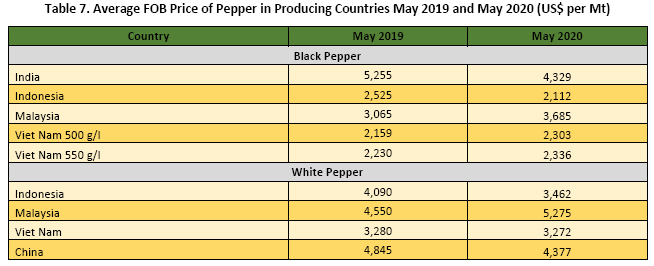
Entering the 4th month of global pandemic, FOB pepper price as of May 2019 and May 2020 reported with negative outlook with only Malaysia and Viet Nam origins were reported increased. India black pepper was reported with 18% deficit as compared to May 2019 at an average of USD 4,329 per Mt. Indonesia black and white pepper were reported with 16% and 15% deficit respectively as compared with May 2019 averaging at USD 2,112 per Mt and USD 3,462 per Mt respectively. Malaysia black and white peppers were reported with an increase of 20% and 16% respectively as compared to May 2019 at an average of USD 3,685 per Mt and USD 5,275 per Mt respectively. Furthermore, Viet Nam black pepper 500 g/l and 550 g/l were reported with an increase of 7% and 5% respectively as opposed to the same period in 2019 at an average of USD 2,303 per Mt and USD 2,336 per Mt respectively whilst Viet Nam white pepper was reported stable with a slight decrease averaging at USD 3,272. Viet Nam's management of the pandemic as well as the surge of demand from China has proven to contribute positively. China white pepper was reported with 10% deficit when compared to May 2019 and was traded at an average of USD 4,377 per Mt (Table 7).
HIGHLIGHT ON INDONESIA
Production and Productivity
Indonesia in 2019 became the third largest pepper producing country in the world after Brazil surpassed Indonesia as the second largest producer in the world. Indonesia produces black and white pepper, black pepper is mostly produced in Lampung, thus, known as Lampung black pepper and white pepper is traditionally produced in Bangka Belitung which is known as Muntok white pepper. Aside from those two regions, West and East Kalimantan, Bengkulu, South Sumatra, Sulawesi as well as Java are also known to produce both black and white pepper, though in slightly smaller capacity.
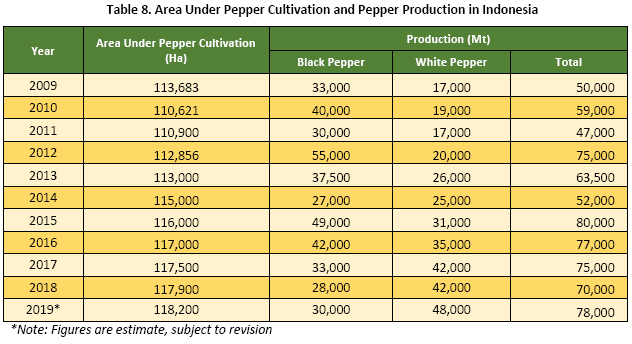
Since 2009-2012 the area under pepper cultivation in Indonesia had shown a decreasing trend. A drop of 1% in term of area of pepper cultivation was reported when comparing 2009 and 2012. As from 2012, the area of pepper cultivation in Indonesia had continuously increased to 2018. In 2018, Indonesia planted pepper on 117,900 Ha of area, recording a 4% increase over the course of 10 years (Table 8).
In addition, the area of pepper cultivation for 2019 was estimated to slightly increased by 0.3% to 118,200 Ha. The increase of the area of pepper plantation would be contributed to the Indonesia government implementation of rehabilitation and expansion programs by opening new pepper gardens in some areas. The policy was implemented to motivate farmers in maintaining their pepper plantation following the continuous unfavourable price of pepper in the past few years and the losing of pepper plants from diseases.
Pepper production of Indonesia had fluctuated since 2009 with a rather positive trend. Pepper production of Indonesia was reported to have recorded an increase of 40% in the past 10 years as it recorded to have produced a total of 70,000 Mt in 2018 which comprised of 28,000 Mt of black pepper and 42,000 Mt of white pepper. The highest production of Indonesian pepper in the past 10 years was reported in 2015 with 80,000 Mt which comprised of 49,000 Mt of black pepper and 31,000 Mt of white pepper. The highest production in 2015 could be contributed to the price of Indonesian pepper peaked at an average of USD 8,967 per Mt (Sep 2014) for black pepper and USD 12,837 per Mt (Dec 2014) for white pepper. Thus, motivated farmers to produce more during that period.
In addition, the production of Indonesian pepper for 2019 was estimated to experience an 11% increase to 78,000 Mt when compared to 2018 as result of the favourable weather condition especially in Lampung area which known as the largest producer of black pepper in Indonesia.
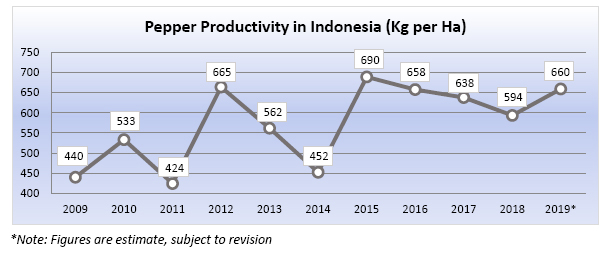
Pepper productivity in Indonesia for the past 11 years fluctuated with a slight positive trend. In the past 11 years pepper productivity in Indonesia was reported to have increased by 50% and by 2019 the pepper productivity was estimated at 660 Kg per Ha. Whilst the highest pepper productivity in Indonesia was reported in 2015 with 690 Kg per Ha. During 2015-2018 the productivity in Indonesia had shown a decreasing trend. A drop of 14% in term of productivity was reported when comparing 2015 and 2018. The decreased of productivity was influenced by many factors, such as unfavourable weather, the emerging of pest and disease and the low price which discouraged farmer in Indonesia in maintaining their plants.
Pepper Export from Indonesia
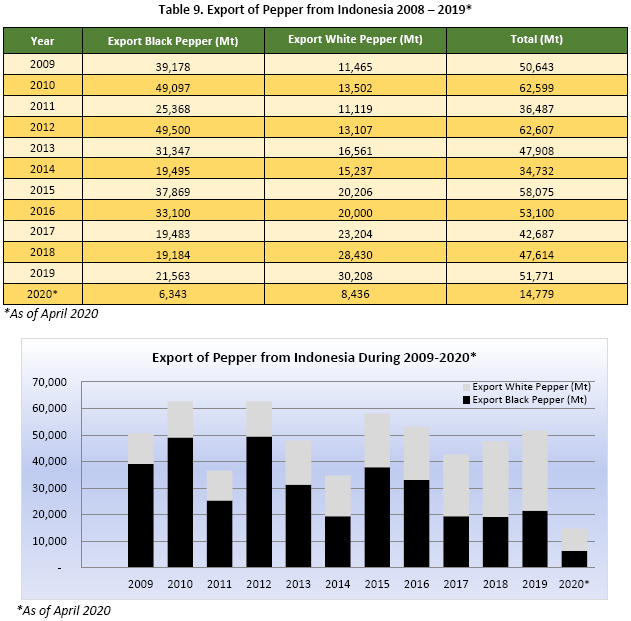
Indonesia, the third largest pepper exporter in the world since Brazil managed to take the second largest pepper exporter position from Indonesia in 2017, had managed to steadily on average export around 50,000 Mt of pepper annually. Since 2009 until 2019 there had been a 2% increase in number of exports from Indonesia. Furthermore, as of 2009 until 2016 pepper export from Indonesia was mainly dominated with black pepper with an average of 69% of the total export figures. However, since 2017 white pepper was reported to have dominated the export of pepper from Indonesia with an average of 57%. The highest pepper export occurred in 2012 with 62,607 Mt whilst the lowest export occurred in 2014 with 34,732 Mt (Table 9). In 2019, pepper export from Indonesia was reported at 51,771 Mt which comprised of 21,563 Mt of black pepper and 30,208 Mt of white pepper, thus, recording an increase of 9% as opposed to the previous year. Furthermore, as of April 2020, pepper export from Indonesia was reported at 14,779 Mt which comprised of 6,343 Mt of black pepper and 8,436 Mt of white pepper, thus, recording a decrease by 5% as compared to the same period in 2019.
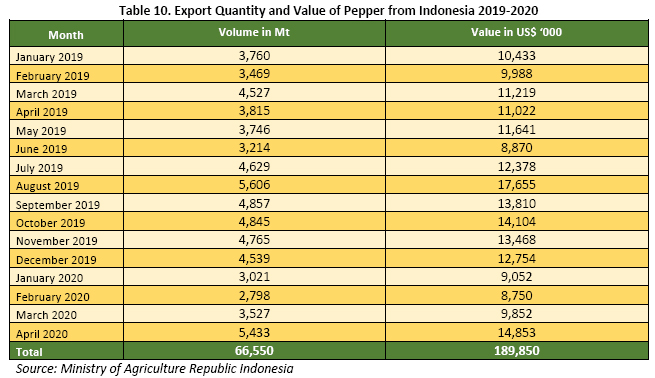
The quantity of pepper exports from Indonesia had reportedly fluctuated in the last 16 months. The total export by Indonesia in the past 16 months was reported at 66,550 Mt with total value as high as USD 189.8 Million. The average pepper export from Indonesia in the past 16 months was reported to be 4,159 Mt per month. The highest pepper export of Indonesia occurred in August 2019 which reached 5,606 Mt whilst the lowest was reported in February 2020 with 2,798 Mt (Table 10). The high level of exports during August 19 correlated to the harvest season occurred during August-October in Indonesia.
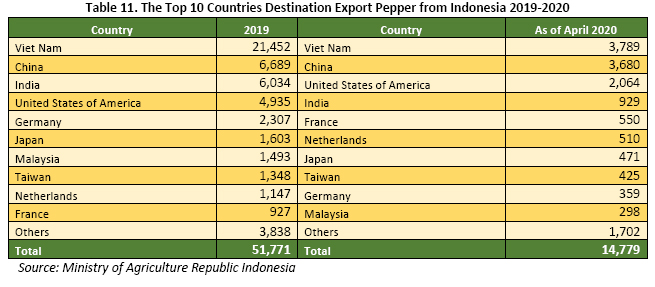
Pepper from Indonesia is exported to various countries around the world mostly in Asia, America and Europe (Table 11). During January 2019-April 2020, the top 10 country of destinations for Indonesia pepper were reported to be Viet Nam with 25,241 Mt (Contributed to 38% of the total pepper export during January 2019-April 2020), China with 10,369 Mt (16%), United States of America with 6,999 Mt (11%), India with 6,963 Mt (10%), Germany with 2,666 Mt (4%), Japan with 2,074 Mt (3%), Malaysia with 1,792 Mt (3%), Taiwan with 1,773 Mt (3%), Netherlands with 1,657 Mt (2%) and France with 1,477 Mt (2%). As presented in the list of the top 10 countries destination of pepper export from Indonesia, it could be infered that Indonesia has only touched the surface when it came to the European markets as it only representated by 3 countries; Germany, Netherlands and France. Therefore, Indonesia ought to explore more on penetrating the lucrative European Market which would only be possible through the improvement of its pepper's quality and safety.
Furthermore relating to the global pandemic, Indonesia pepper export in the first quarter of 2018, 2019 and 2020 were reported fluctuated with negative outlook. In the first quarter of 2019, Indonesia pepper export was reported with an increase of 29% in term of quantity as opposed to the same period in 2018 to a total of 15.570 Mt, although increasing in term of quantity, the revenue of pepper export by Indonesia was reported with 6% deficit as compared to the same period in 2018 to a total of USD 42.6 Million. As for the first quarter of 2020, pepper export by Indonesia showed a decreasing trend. The total pepper export by Indonesia was reported with a 5% deficit as compared to the same period in 2019 to a total of 14.779 Mt. In accordance to decreasing in term of quantity, the revenue of pepper export by Indonesia was reported with marginal 0.4% deficit as compared to the same period in 2019 to USD 42.5 Million.
Pepper Price
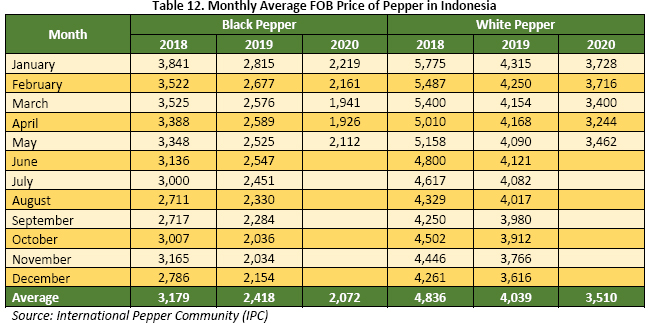
FOB price of Indonesia pepper had fluctuated significantly in the past three years which could be attributed to the world supply of pepper significantly exceeding the global demand. In 2018, the average FOB price for Indonesia black pepper was reported at USD 3,179 per Mt with the highest price recorded in January with USD 3,841 per Mt whilst the lowest price was reported in August with USD 2,711 per Mt. Furthermore, the average FOB price for Indonesia white pepper was reported at USD 4,836 per Mt with the highest prices recorded in January with USD 5,775 per Mt whilst the lowest price was reported in September with USD 4,250 per Mt.
In 2019, the average FOB price of Indonesia black and white pepper were reported with a decrease by 24% and 16% respectively when compared to the previous year. The average FOB price of Indonesia black pepper was reported at USD 2,418 per Mt with the highest price recorded in January with USD 2,815 per Mt whilst the lowest price occurred in November with USD 2,034 per Mt. Furthermore, the average FOB price of Indonesia white pepper was reported at USD 4,039 per Mt with the highest price recorded in January with USD 4,315 per Mt whilst the lowest occurred in December with USD 3,616 per Mt.
In the course of January until May 2020, the average FOB price of Indonesia black and white pepper were reported at USD 2,072 per Mt and USD 3,510 per Mt respectively, thus recording 21% and 16% deficit respectively as compared to the same period in 2019 (Table 12).
Source:
- Brazil, Unofficial source (Coreimex, CSG Trade)
- India: AISEF, NCDEX, Indian Chamber of Commerce & Industry, Spices Board India
- Indonesia: Unofficial source
- Malaysia: Malaysian Pepper Board
- Sri Lanka: Department of Export Agriculture
- Viet Nam : Viet Nam Pepper Association, HCMC
- China: Hainan Pepper Association, China Spice Association
- Office of Agricultural Economics of Thailand
- A.A. SAYIA & Company
- International Trade Centre (ITC) - Geneva
Note: Some of the data in this publication are from the IPC database. The data are obtained from official reports and correspondence between the IPC and Sri Lanka and have been processed based on statistical norms that can be accounted for.
Previous Publications
- Market Review - August 2017
- Market Review - July 2017
- Market Review - June 2017
- Market Review - May 2017
- "Market Review - April 2017 "
- Market Review - March 2017
- Market Review - February 2017
- Market Review - January 2017
- Market Review - December 2016
- Market Review - November 2016
- Market Review - October 2016
- Market Review - September 2016
- Market Review - August 2016
- Market Review - July 2016
- Market Review - June 2016
- Market Review - May 2016
- Market Review - April 2016
- Market Review - March 2016
- Market Review - February 2016
- Market Review - January 2016
- Market Review - December 2015
- Market Review - November 2015
- Market Review - October 2015
- Market Review - September 2015
- Market Review - August 2015