a UNESCAP Intergovermental Organization
a UNESCAP Intergovermental Organization
Monthly Publication
Market Review - January 2017
General
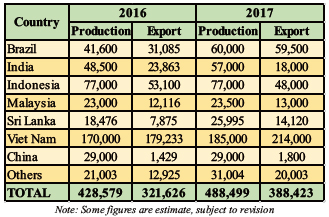
As reported earlier, pepper market continued to be declining trend in 2017, where price of pepper prevailed in 2017 was significantly lower when compared with the price in 2016 and 2015. Continuous increase of global production and export in 2017 is the main reason for the continuing decrease of price. In 2018 production of pepper is estimated to remind high, but slightly lower from 2017. Although new plants in some countries have started produce, weather condition however, particularly in Viet Nam during flowering season, is not as good as in the past year. Hence, production of pepper this year may not as good as last year. Considering the above situation, pepper market in 2018 would largely depend on developments in production during the year. In the short term, the market may be affected by the situation of harvesting season in India and Viet Nam. Viet Nam as the largest producing and exporting country will continue to play important role in determining market direction. Revised estimate figures on production and export during 2016 and 2017 are given below.
Table 1.
Production and Export of Pepper in 2016-2017 (Quantity in MT)
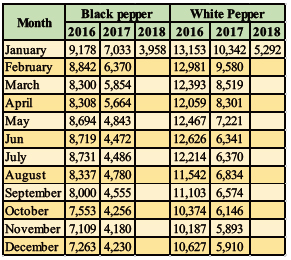
During January 2018, the market has slowed down. Pepper price index decreased by 3.7 and 6.0 points respectively for black and white pepper (Table 2). The composite price of black pepper decreased by 6.4% from US$ 4,230 per MT to US$ 3,958 per MT in December 2017, while that of white pepper decreased by 10.4% from US$ 5,910 per MT in December 2017 to US$ 5,292 in January 2018 (Table 2). The decrease of the composite price index was mainly due to significant decrease of price prevailed in Viet Nam, the largest supplier accounted for about 12%. Although pepper price in India increases but its export quantity is not really significantly strong enough to compensate for the decrease taken place in other countries.
Table 2.
IPC Price Index (Base Year: Average 2011 - 2015)
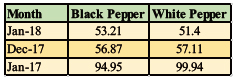
Table 3.
Composite Price of Black and White Pepper (US$/MT)
HIGHLIGHT ON INDIA
Production
In India, pepper is one of most important spice and traditionally grown mainly in Kerala, Karnataka and Tamil Nadu but also extended to cultivate in Andhra Pradesh, Orissa, Maharasthra, Goa, Assam, Meghalaya, Tripura etc. In practice, pepper is grown mostly as a mixed crop with coffee and tea and is climbed up in coconut and areca nuts. Pepper cultivated as mono-crops is limited at certain areas only.
Pepper in India is cultivated at small farm mostly in rural areas. Area under pepper cultivation is reported at around 131,000 hectares with an average production of around 55,000 MT annually. In 2017, production of pepper in India was 57,000 MT recorded an increase of 18% from 48,500 MT in 2016. From current harvest early 2018, it is expected a volume of 65,000 MT is obtained, representing an increase of 14%. The continuous increase in the last two years 2016-2017 was a result of continuous efforts taken place, particularly in response to the continuous increase of price in the past decade (2006- 2015) to rehabilitate, replant and enlarge pepper farms.
India has a fairly advanced spice industry, especially processed products such as powder, dehydrated products, oil and oleoresin and other byproducts. The absorption of spices from pepper for the purposes of the industry is very high. Therefore, besides absorbing pepper from its own production, India have to import significant quantity outside which mainly comes from Viet Nam and Sri Lanka where price is very competitive.
Export and Import of pepper by India
According to Trade Statistics of the ITC, India exported (including import for re-export) 23,863 MT of pepper valued at US$ 188 million in 2016, consisting of 11,816 MT of whole pepper and 12,047 MT of ground pepper. The United States of America was the main market for India. To meet huge internal demand, India also imported significant quantity, mainly for industrial use of oil and oleoresin. In 2016 India imported 23,484 MT mainly from Viet Nam and Indonesia.
During 2017, production of pepper in India was 57,000 MT, a 14% higher than 2016. However, total export from India in 2017 is estimated to be lower while import would be higher. This was due to limited stocks brought forward from last year and increased internal demand coupled with significantly lower prices of pepper from Viet Nam.
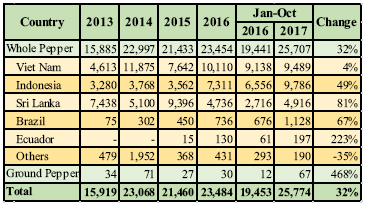
During January – October 2017, export from India was 15,362 MT as against 19,878 MT in the same period last year while for import it has reached 25,774 MT as against 19,453 MT in the corresponding period of last year. Up to December 2017 a volume of 18,000 MT is estimated to have recorded as export and 33,000 MT as import. Some sources even reported that import of India in 2017 is around 40,000 MT
It is interesting to note that in the last few years, percentage share of whole pepper export decrease year by year while for ground pepper increased. Up to October 2017, total export decreased by 23%. Out of this, whole pepper decreased 33% while for ground pepper only 12%. It means portion of ground pepper export increased further. The following tables will explain the situation.
Table 4.
Export and Re-export of Whole Pepper from India in MT
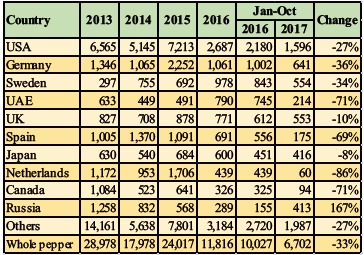
Table 5.
Export and Re-export of Ground Pepper from India in MT
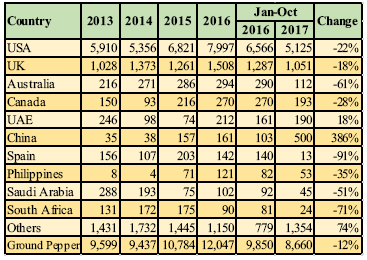
Table 6.
Total Export and Re-export of Pepper from India in MT
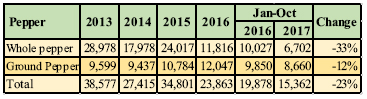
Table 7.
Total Import of Pepper of India by country in MT
Pepper Price in India
Pepper price in India is relatively higher than price prevailed in other producing countries. The situation is reported due to huge internal demand where pepper produced in the country is easily absorbed by domestic market. Pepper exported from India is only for high grade quality and other value added products.
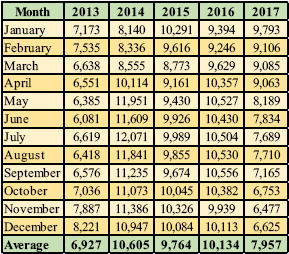
In 2017 pepper price decreased drastically. In Kochi, local price of Malabar black decreased by 37% from INR 654 per Kg in January 2017 to INR 412 in December 2017. In January 2018 average price of pepper in India increased by 3% to INR 420 per Kg while in other countries decreased except Sri Lanka. FOB price of Malabar Garbled 1 increased in January from US$ 6,625 per MT to US$ 6,802.
The price increase during harvesting season was likely due to the Indian government's efforts to restrict imports of pepper which is now has flooded Indian market by imposing Minimum Import Price regulations at INR 500 per Kg. This policy is intended to protect pepper farmers from further declining prices following Vietnamese pepper entering India in large quantities at competitive lower prices.
Table 8.
Weekly average price of pepper in Kochi, India in US$ per MT
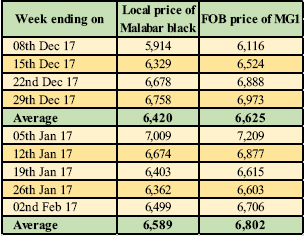
Table 9.
Monthly average local price of Malabar black pepper in Kochi in INR/100 Kg
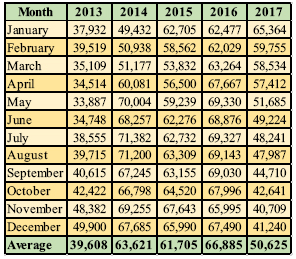
Table 10.
Monthly average FOB price of Malabar black pepper in Kochi in US$/MT
Previous Publications
- Market Review - July 2015
- Market Review - June 2015
- Market Review - May 2015
- Market Review - April 2015
- Market Review - March 2015
- Market Review - February 2015
- Market Review - January 2015
- MARKET REPORT 2014
- Market Review - November 2014
- Market Review - October 2014
- Market Review - September 2014
- Market Review - July 2014
- Market Review - June 2014
- Market Review - April 2014
- Market Review - February 2014
- Market Review - December 2013
- Market Review - November 2013
- Market Review - August 2013
- Market Review - June & July 2013
- Market Review - May 2013
- Market Review - April 2013
- Market Review - March 2013
- Market Review - February 2013
- MARKET REVIEW 2012
- Market Review - November 2012