
a UNESCAP Intergovermental Organization
a UNESCAP Intergovermental Organization
Monthly Publication
MARKET REVIEW - February 2019
PRICE HISTORY
Price index for February 2019 experienced a declining trend both for black and white pepper. Index price of black pepper was reported to have lost 2.96 points thus recording 8.4% loss when compared to the previous month and 34% loss compared to February 2018. Index price of white pepper also recorded a loss of 2.35 (Table 1) points which resulting to a 6.2% loss when compared to January 2019 and 30% loss when compared to February 2018.
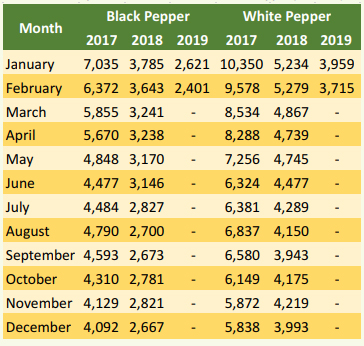
Composite price of black pepper in February 2019 was reported at USD 2,401 per Mt, recording USD 220 loss of the previous month which was at USD 2,621 per Mt (Table 2). Index price of white pepper was reported to decline by USD 244 per Mt when compared with January 2019 and standing at level of USD 3,715 per Mt.
Table 1. IPC Price Index (Base price: Average 2011-2015)
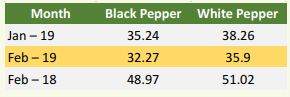
Table 2. Composite Price of Black and White Pepper (US$/MT)
Entering the 2nd month in 2019, the market showed a mixed response. Farm gate price of black pepper in India has been reported to continue to decline since the beginning of 2019. In February 2019 the farm gate price of black pepper in India was reported to be USD 4,883 per Mt, recording a 2% decline compared to the previous month. The decline in prices in India was caused by the presence of illegal imports entering India through the border area. Black pepper from Viet Nam was known to have entered the Indian market through Sri Lanka and Pakistan. Pepper from Viet Nam was reshipped using pepper brands from Sri Lanka (under the India - Sri Lanka Free Trade Agreement) and Nepal, so it could easily enter the Indian market.
Farm gate price of Lampung black pepper in Indonesia was also reported to have declined in February. The decline in prices in Indonesia was reported to reach 4% compared to the previous month. From January to February, several pepper gardens in Lampung were harvested, although they had not reached the peak. Based on reports from farmers in Lampung, prices at the farm level in Rupiah were reported between Rp. 30,000 to Rp. 32,000 per Kg depending on the location and quality of the pepper. Currently pepper farmers in Lampung were experiencing quite difficult times because the price of pepper continues to decline. This condition caused farmers to be less passionate in taking care of their gardens. Even though there were several well-maintained gardens, most of the gardens in Lampung currently lacked of intensive attention from farmers. Pepper prices that continued to decline resulting in a very low margin between production cost and selling prices. Some farmers were reported still holding on their pepper while waiting for prices to improve.
Malaysia is one country that has a fairly stable pepper price in 2019. In February, the average farm gate price of black pepper in Malaysia was reported to be USD 2,293 per Mt, experiencing a slight 1% increase compared to the previous month. In local currency, the price of black pepper in Malaysia was reported to be unchanged compared to January. The increase in prices in Malaysia was caused by fluctuations in the Malaysian Ringgit against the US Dollar. The Malaysian government through the Malaysian Pepper Board reportedly releases policy to help protect pepper farmers from fluctuations in pepper prices globally.
Just like prices in India and Indonesia, the farm gate price of black pepper in Viet Nam has reportedly declined since the beginning of the year. The decline in prices in Viet Nam this month was reported to be quite drastic, declining 9% compared to January. February was the peak of the harvest period in some provinces in Viet Nam, causing the pepper stock to be quite high. The high quantity of pepper stock which was not accompanied by high absorption by the market caused prices to continue to decline. A strategy is needed so that pepper could be absorbed by both domestic and international markets. Value added pepper product is one of the opportunities and challenges for pepper industry players in the world, especially in Viet Nam in facing the current price problems. Although Viet Nam's production figures are still predicted quite high, the Viet Nam harvest in February 2019 had decreased slightly compared to the same period last year. The decline in production was due to Viet Nam Government's policy that focused more on product quality than product quantity. This policy is expected to be one solution to the problem of pepper prices in the world. Viet Nam, known as the largest pepper producer in the world, puts a considerably influential pressure on wold pepper price movement.
The farm gate price of black pepper in Sri Lanka showed a positive trend. In February 2019, the farm gate price of black pepper in Sri Lanka was reported to be USD 3,234 per Mt, experiencing a 2% increase compared to the previous month. Sri Lanka is known to have good quality black pepper, and non-excessive production of black pepper in Sri Lanka is one of the factors affecting the stable price of black pepper in Sri Lanka. In addition, the political condition that began to show a positive impression was also one of the factors supporting the stable prices of pepper in Sri Lanka.
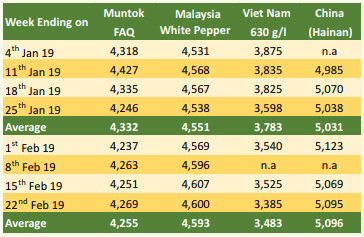
The FOB price of black pepper in India in February was reported to be USD 5,164 per Mt, declining by 2% compared to FOB price in the previous month. In Indonesia, the FOB price of Lampung Black Pepper was reported to have declined 3% compared to the previous month, in February the average FOB price of Lampung Black Pepper was recorded at USD 2,718 per Mt. Furthermore, the FOB price of black pepper in Malaysia experienced a significant increase compared to the previous month. In February, the average FOB price of black pepper in Malaysia was reported to be USD 3,028 per Mt, experienced an increase of USD 28 per Mt from the previous month. The FOB prices of Viet Nam black pepper (500 g/l) and (550 g/l) were reported to be at USD 2,148 per Mt and 2,253 per Mt respectively, declining by 1% and 14% respectively as compared with the previous month.
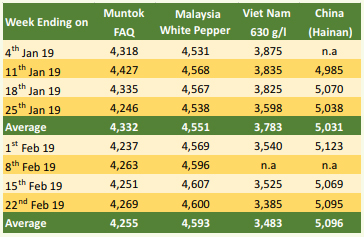
Farm gate prices trend of white pepper also showed mixed response. The average FOB price of Muntok White Pepper from Indonesia in February 2019 was reported to be USD 3,608 per Mt, declining by 2% when compared to the previous month. As one of the well-known pepper brands in the world, Muntok White Pepper has a fairly broad market in the pepper industry. However, the global oversupply in the past years has continued causing Muntok White Pepper price to be pushed down which progressing to the 2nd month in 2019.
Furthermore, based on reports from farmers in the Bangka Belitung Islands, farmers are currently facing technical problems in terms of pepper cultivation. Farmers in Bangka Regency complained of stem rot and pepper yellowing disease. Whereas, in Belitung Regency, farmers' gardens were more affected by pepper yellowing disease compared to stem rot disease. Stem rot caused by Phytophthora sp. is one of the diseases that could spread quite quickly. Delays in preventing this disease could cause considerable losses. Plants that are attacked by stem rot will generally die within a few days of being attacked. Wrong handling of this disease could actually cause spores from the fungus Phytopthora sp. spread throughout the garden and infect plants that are still healthy. While pepper yellowing disease is a disease caused by infection with 3 types of pathogens, namely the parasitic nematode Meloidogyne spp. and Radopholus spp., which synergizes with phytopathogenic fungi Fusarium sp. Soil conditions in the Province of Bangka Belitung Islands that are quite sandy are ideal conditions for nematode growth that causes pepper yellowing disease.
At present, more farmers do not preserve the plants that have been attacked by both types of diseases. Farmers in the Province of Bangka Belitung Islands do not use synthetic chemical pesticides to deal with the disease problem which is caused by farmers' awareness to keep their products free from pesticide residues. Farmers have begun to realize that the use of synthetic chemical pesticides will cause the quality of the end-product to decline and be difficult for potential buyers to accept. In addition, the use of synthetic chemical pesticides will burden the production costs which is avoided by farmers in order to obtain lower production costs so that profits will be higher. The use of biological agents from groups of bacteria and fungi to prevent disease in pepper is still less attractive to farmers in this area. The impracticality in the use of biological agents, the short shelf life of biofertilizer and biopesticide products, and the fairly routine application causes farmers to be less interested in beneficial microbial-based products. In addition, non-instant results are also one of the disadvantages of microbial-based products. Continued education is needed so that farmers can accept this environmentally friendly and low-cost product.
Farm gate prices of white pepper in Malaysia and China showed an increase in prices, albeit insignificant. The average farm gate prices of Malaysian white pepper in February was reported to be USD 3,858 per Mt, while in China it was USD 4,896 per Mt. Price changes in these two countries were caused by fluctuations in the local currency against the US Dollar. Furthermore, the farm gate price of Viet Nam White Pepper was reported to have declined by 12% compared to the previous month. As of February 2019, the average farm gate price of Viet Nam white pepper was reported to be USD 3,110 per Mt, experiencing price reductions of up to USD 435 per Mt compared to the previous month's price of USD 3,545 per Mt.
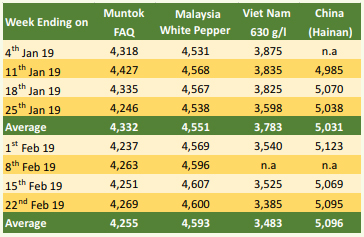
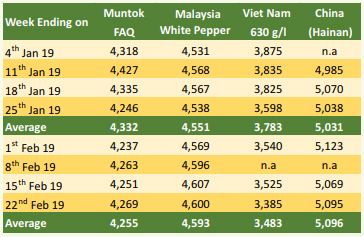
The FOB prices of white pepper in producing-countries were reported to have the same trend as the farm gate price of white pepper. The FOB price of White Pepper in Indonesia was reported to be USD 4,255 per Mt, in Malaysia USD 4,593 per Mt, in Viet Nam USD 3,483 per Mt, and in China USD 5,096 per Mt. The reduction in FOB price occurred in Indonesia and Viet Nam by 2% and 8% respectively. Whereas in Malaysia and on China FOB the price of white pepper has increased albeit insignificant.
HIGHLIGHT ON BRAZIL
Production and Productivity
As a country that has a tropical climate and fertile soil, Brazil is a country that has a large wealth of natural resources. Various plants from groups of vegetables, fruits, wood plants, and herbs and spices can flourish in this country. One plant that can grow well and is currently being cultivated quite intensively in Brazil is pepper.
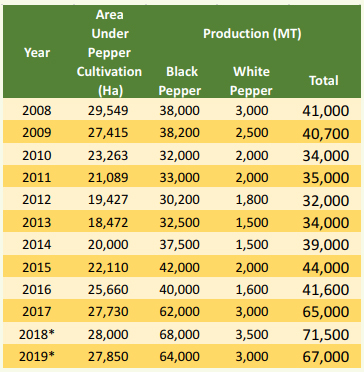
Brazil is famous for its Black Pepper which has quite affordable prices in the pepper industry. Pepper plants have long been cultivated in Brazil, and are one of the mainstay agricultural products in Brazil. Since 2008 until now, the area under pepper plantations in Brazil has been fairly fluctuated. In 2008, the area under pepper cultivation in Brazil was reported to reach 29.549 Ha, while in 2019 the area under pepper cultivation in Brazil was predicted to be around 27,850 Ha. The trend of land area from 2008 to 2013 has declined, while since 2013 up to now the trend of pepper area in Brazil has increased. Since 2013 the rising trend of pepper prices has caused many farmers in Brazil to be interested in cultivating pepper. Even though since 2015 until now the price trend has declined, but pepper still a favourite and is cultivated intensively in Brazil which shows that farmers in Brazil still look positively towards the pepper industry in the future.
As a producer of black pepper, the average production of Brazilian black pepper reaches 95% of the total annual pepper production, while the remaining 5% is white pepper. Total pepper production in Brazil from 2008 to 2019 (estimates) has been reportedly fluctuated. In 2008 to 2014 pepper production in Brazil tended to decline. Whereas since 2015 pepper production in Brazil has begun to increase. Increased production in Brazil was due to the many new gardens that were beginning to produce. Furthermore, in 2019 it is estimated that pepper production in Brazil will reach 67,000 Mt consisting of 64,000 Mt black pepper and 3,000 Mt white pepper.
Brazil is famous for its black pepper which has good quality but has a lower price compared to black pepper from other producing-countries. Low prices in Brazil do not necessarily make farmers experiencing a damnification. This is due to the advanced technology of pepper cultivation in Brazil, such as the use of automatic irrigation, fertilizer inputs according to land requirements, and the use of semi-automatic tools in the harvest and post-harvest process. The use of technology causes the production costs incurred by Brazilian farmer to be low, not paying much labour costs, resulting in profit being made even though sold at low prices.
*Note: Figure are estimate, subject to revision
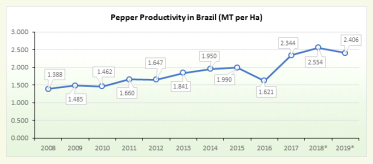
The advancement of technology in Brazil is shown by the productivity trend of pepper which tends to increase since 2008 until 2019 (estimation). The use of good varieties and free of disease seedling are one of the keys to success in pepper cultivation. Plant breeding techniques combined with the Good Agricultural Practices and Integrated Pest Management system will provide maximum results on pepper productivity.
In 2008, productivity of pepper in Brazil was reported to be 1,388 Mt per Ha, and continued to increase up to 1,990 Mt per Ha in 2015. However, in 2016 Brazil's productivity decreased to 1,621 Mt per Ha, and increased quite high in 2017, thus reaching, 2,344 Mt per Ha. In 2019 Brazil's productivity is predicted to reach 2,406 Mt per Ha.
Pepper Export from Brazil
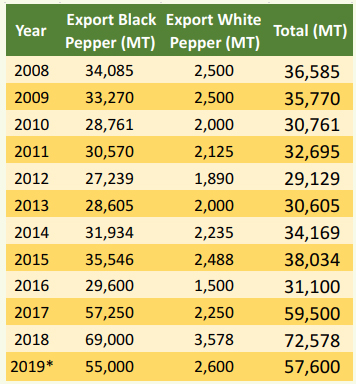
With high enough pepper production, Brazil has climbed up to be the second largest pepper exporter just behind Viet Nam. From 2008 to 2013, Brazil's exports tended to decline. In 2008 Brazil was known to export 36,585 Mt of pepper consisting of 34,085 Mt of white pepper and 2,500 Mt of black pepper. Whereas, in 2013 Brazil exported 30,605 Mt of pepper consisting of 28,605 Mt white pepper and 2,000 Mt black pepper. Brazil's exports in 2013 reported a decline of up to 16% compared to the export quantity in 2008.
Positive trends began to be shown from 2013 to 2019 (estimation). Despite fluctuations, the trend of Brazil's exports shows an increase in quantity. In 2018 Brazil exported 72,578 Mt of pepper which comprised of 69,000 Mt white pepper and 3,578 black pepper. This figure is the highest since 2008. Meanwhile, in 2019 Brazil's exports are expected to decline compared to exports in 2018. It is estimated that Brazil will export 57,600 Mt of pepper consisting of 55,000 Mt white pepper and 2,600 black pepper which is a result from a decrease in production due to unproductive new garden.
*Note: Figure are estimate, subject to revision
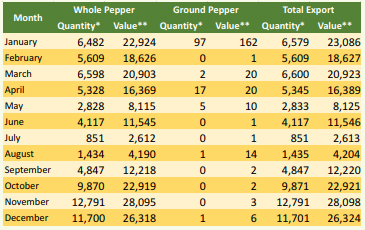
In 2018, exports from Brazil mostly occur in November with a quantity of 12,791 Mt and a value of USD 28 million. Based on these figures, it is known that the average value of Brazilian exports in November was USD 2,197 per Mt. The export value per Mt is the smallest in 2018. While the highest export value per Mt is found in January with a export volume of 6,579 Mt and a value of USD 23 million, resulting in a value of USD 3,509 per Mt. Meanwhile, for the average export value per Brazilian Mt in 2018 is USD 2,836 per Mt.
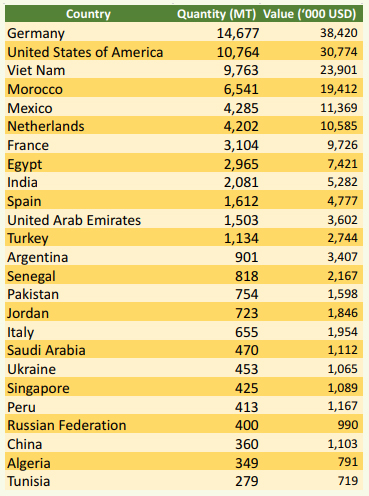
Whole pepper from Brazil was reportedly exported to various countries in the world. In 2018, Germany was the country that imports the most pepper from Brazil with a quantity of 14,677 Mt and a value of USD 38.4 million. Another country that imports pepper from Brazil was the USA with a quantity of 10,764 Mt, followed by Viet Nam (9,763 Mt), Morocco (6,541 Mt), Mexico (4,285 Mt), and other countries. In addition to the 25 countries listed in Table 10, Brazil also exported to other countries in an insignificant amount.
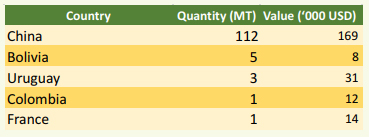
Furthermore, 2018 saw most of ground pepper from Brazil exported to China with a quantity of 112 Mt, followed by Bolivia (5 Mt), Uruguay (3 Mt), Colombia (1 Mt), and France (1 Mt). Although export to Bolivia had a larger quantity than Uruguay, Colombia and France, but in value export to Bolivia it was smaller.
Previous Publications
- Market Review - July 2015
- Market Review - June 2015
- Market Review - May 2015
- Market Review - April 2015
- Market Review - March 2015
- Market Review - February 2015
- Market Review - January 2015
- MARKET REPORT 2014
- Market Review - November 2014
- Market Review - October 2014
- Market Review - September 2014
- Market Review - July 2014
- Market Review - June 2014
- Market Review - April 2014
- Market Review - February 2014
- Market Review - December 2013
- Market Review - November 2013
- Market Review - August 2013
- Market Review - June & July 2013
- Market Review - May 2013
- Market Review - April 2013
- Market Review - March 2013
- Market Review - February 2013
- MARKET REVIEW 2012
- Market Review - November 2012