
a UNESCAP Intergovermental Organization
a UNESCAP Intergovermental Organization
Monthly Publication
MARKET REVIEW - July 2019
PRICE HISTORY
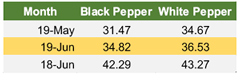
Price index showed a mixed response in the start of the second semester of 2019. Price index of black pepper was reported with a drop of 1.42 points to 33.58. As compared with the same period in 2018 the price index of black pepper was reported with 12% decrease. In contrast, price index of white pepper in July 2019 was reported to be stable at 36.42 (Table 1). However, when compared to the same period in 2018 the price index of white pepper was reported the same 12% decrease as for black pepper.
Table 1. IPC Price Index (Base price: Average 2011-2015)
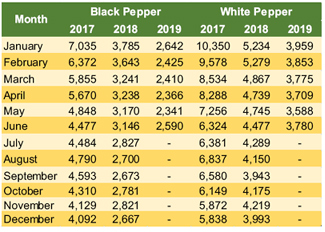
Composite prices for July 2019 were reported with a rather polar outlook. Composite price of black pepper was reported at USD 2,498 per Mt (Table 2) or losing USD 106 per Mt as compared to the previous month. Whilst, composite price of white pepper was reported to be stable and relatively unchanged at USD 3,768 per Mt.
Table 2. Composite Price of Black and White Pepper (US$/Mt)
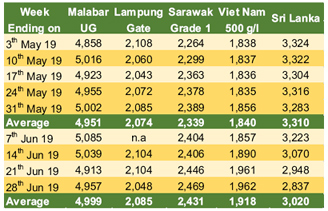
Pepper prices in the 7th month of 2019, showed a mixed response with a rather negative outlook as only Malaysian origin was reported with an increased. The farm gate of black pepper in India was reported at an average of USD 4,867 per Mt (Table 3). Thus, recording a 3% deficit when compared with June 2019. The decrease in price of black pepper in India could be contributed to the decrease of the price in the local currency which dropped to an average of INR 335 per Kg from INR 346 per Kg in June 2019. The price of black pepper in Indonesia (Lampung Black pepper) had also weakened when compared to June 2019. The farm gate prices of Lampung black pepper for July 2019 was reported to be at USD 2,011 per Mt, recording a decrease of USD 74 per Mt or 4% as compared to the previous month. The decrease in price of black pepper price in Indonesia could be contributed to the harvest season currently in full swing, thus, pushing the local price to an average of IDR 28,000 per Kg. Following the favorable weather condition this year, Lampung harvest is estimated to produce a higher yield.
The farm gate price of black pepper in Malaysia was reported with a slight increase of 1% when compared with June 2019. The farm gate price of Malaysia black pepper was reported at an average of USD 2,445 per Mt. The increase of Malaysian black pepper price aligned with the strengthening of Malaysian Ringgit towards US Dollar (averaging at MYR 4.12 for USD 1). Farm gate price of black pepper in Viet Nam for July 2019 was reported stable with an average of USD 1,924 per Mt. As the harvest coming in full swing, the farm gate of Sri Lanka black pepper continued to record a significant deficit. In July 2019, the farm gate price of black pepper in Sri Lanka was reported at USD 2,602 per Mt, recording a deficit by 14% as compared to June 2019.
Table 3. Farm Gate Prices of Black Pepper (US$ per Mt)
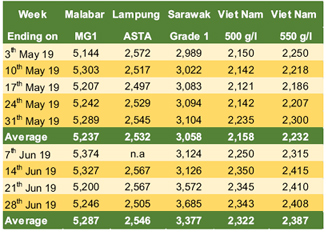
FOB price of black pepper was reported to have experienced the similar response as farm gate prices. Despite the strengthening of Indian Rupee towards US Dollar, the new arrival of new crops in the market pushed down the FOB price of black pepper in India by 2% as compared with the previous month and was reported at an average of USD 5,157 per Mt. Furthermore, following a good crop at the end of the harvest season the FOB price of black pepper in Indonesia was also reported to have decrease by 3% as opposed to previous month averaging at USD 2,464 per Mt. FOB price of Malaysian black pepper as released by Malaysian Pepper Board was reported with a significant 9% spike as opposed to the previous month, averaging at USD 3,685 per Mt (Table 4). Meanwhile, FOB price of Viet Nam black pepper 500 g/l and 550 g/l were reported with a slight decrease of 1% as compared to the previous month with an average of USD 2,298 per Mt and USD 2,363 per Mt respectively. The decrease of Viet Nam FOB price of black pepper was the combination of inactivity and greater competition.
Table 4. FOB Prices of Black Pepper (US$ per Mt)
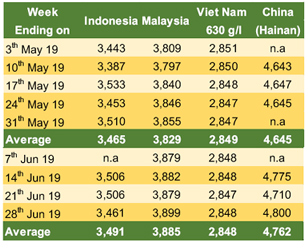
Farm gate prices white pepper in Indonesia, Malaysia and China showed mixed response (Table 5). As Indonesian harvest of Muntok white pepper came to full swing, Muntok white pepper was reported with a slight 1% decrease as compared to the previous month and was traded at an average of USD 3,453 per Mt. In local currency, the price of Muntok white pepper was reported at an average of IDR 48,500 per Kg. Continuing the increasing trend of black pepper price, farm gate price of Malaysia white pepper was reported with a 1% increase as compared with the previous month and was traded at an average of USD 3,920 per Mt. Furthermore, Viet Nam white pepper was reported stable at an average of USD 2,847 per Mt. Whilst China white pepper was traded with a 1% deficit as opposed to the previous month at an average of USD 4,699 per Mt following the harvest season in Hainan, China.
Table 5. Farm Gate Prices of White Pepper (US$ per Mt)
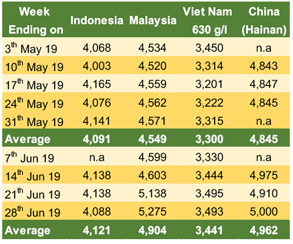
FOB price of white pepper was reported to have experienced the similar responses as farm gate. FOB price of white pepper in Indonesia for July 2019 was reported with a slight deficit by 1% when compared to June 2019 and was reported at an average of USD 4,082 per Mt. Furthermore, FOB price of Malaysia white pepper was reported with a significant increase of 8% as compared to the previous month, averaging at USD 5,275 per Mt. Furthermore, Viet Nam and China origins were reported stable, trading their white pepper at an average of USD 3,448 per Mt and USD 4,949 per Mt respectively (Table 6).
Table 6. FOB Prices of White Pepper (US$ per Mt)
HIGHLIGHT ON SRI LANKA
Production and Productivity
Sri Lanka, also known as Ceylon, is one of pepper producing countries with production of pepper around 20,000 Mt for 2018. Sri Lanka produces a very distinctive black pepper which resulted to a substantial selling price just behind Malabar black pepper. Though Sri Lanka is known for its black pepper, it also produces white pepper in a small scale.
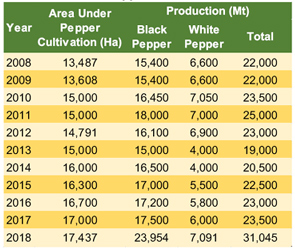
Since 2008, the area under pepper cultivation in Sri Lanka had shown an increasing trend. In 2013, the area under pepper cultivation was reported to have increased by 6% to 31,997 Ha as compared to 2008. However, a decrease of 2% in term of area of pepper cultivation was reported in the following year. Starting 2015, the area of pepper cultivation in Sri Lanka had continuously increased until 2018. In 2018, Sri Lanka planted pepper on 40,241 Ha of area, recording a 33% increase or 10,085 Ha of area when compared to 2008 (Table 7).
Sri Lanka pepper production was reported fluctuating in the past 11 years with the highest yield reported to be in 2017, totaling at 29,545 Mt while the lowest yield was reported in 2011 with only 10,834 Mt. In 2018, Sri Lanka production was reported at 20,135 Mt. Thus, recording a loss of 32% as compared to the same period in 2017. However, when compared to 2008 Sri Lanka production had increased by 56%.
Table 7. Area Under Pepper Cultivation and Pepper Production
Pepper productivity in Sri Lanka in the past 11 years was reported fluctuated. From 2008 until 2018 pepper productivity in Sri Lanka was reported to increase by 17%. Furthermore, the highest pepper productivity in Sri Lanka was reported in 2015 with 890 Kg per Ha. In 2018, pepper productivity in Sri Lanka was reported with a decrease by 39% as compared with the previous year (Chart 1).
Chart 1 Pepper Productivity 2008-2018
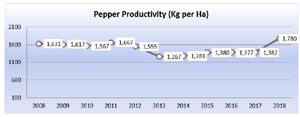
*Note: Productivity = Total production (Kg)/Area under pepper cultivation (Ha)
Pepper Export from Sri Lanka
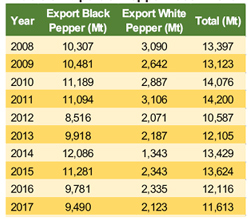
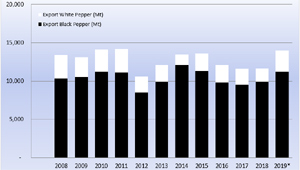
Known as one of pepper origin country, Sri Lanka considered as one of the biggest pepper producers in the world, Sri Lanka's contribution to the global pepper export come sixth behind Viet Nam, Brazil, Indonesia, India and Malaysia. Since 2008 until 2018 there had been a spike of 110% increase of pepper exports from Sri Lanka (Table 8) which amounted to 6,881 Mt increase in quantity. The highest quantity of pepper export from Sri Lanka was reported during 2013 which amounted to 21,328 Mt which comprised of 21,278 Mt of black pepper and 50 Mt of white pepper.
Year 2018 saw a slight decrease in terms of export by Sri Lanka. Sri Lanka was reported to have exported a total of 13,118 Mt which comprised of 12,527 Mt of black pepper and 592 Mt of white pepper. Thus, recording a decrease of 195 Mt as compared with the previous year.
Table 8. Export of Pepper 2008 - 2018
*Note: Figure are estimate, subject to revision
Chart 2. Export of Pepper 2008-2018
*Note: Figure are estimate, subject to revision
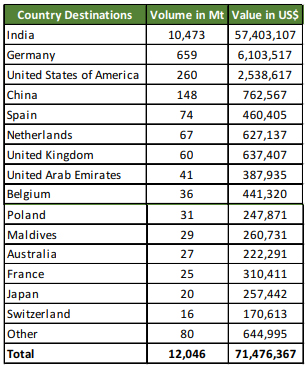
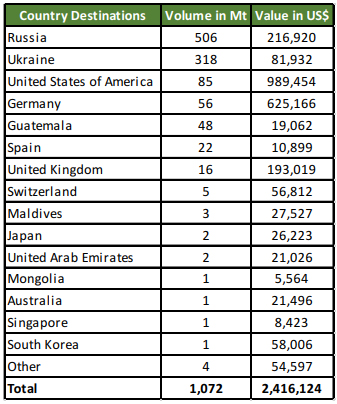
Pepper from Sri Lanka both whole and ground is exported to various countries in throughout the world. In 2018, Sri Lanka was reported to have exported a total of 13,118 Mt of pepper from which 92% or 12,046 Mt of it comprised of whole pepper and 8% or 1,072 Mt of it ground pepper. The total revenue of Sri Lanka export in 2018 was reported to be as high as USD 73.9 Million, thus, recording an average price of the total pepper exported by Sri Lanka at USD 5,934 per Mt for whole pepper and USD 2,254 per Mt for ground pepper.
Furthermore, in 2018, Sri Lanka's top 5 country destinations for whole pepper were reported to be India with 10,473 Mt (Approximately 87% from total export by Sri Lanka), Germany with 659 Mt, United States of America with 260 Mt, China with 148 Mt and Spain with 74 Mt (Table 9). Whilst, Sri Lanka's top 5 country destinations for ground pepper were reported to be Russia with 506 Mt (Approximately 47% from total export by Sri Lanka), Ukraine with 318 Mt, United States of America with 85 Mt, Germany with 56 Mt and Guatemala with 48 Mt (Table 10).
Sri Lanka's high export figures to India was the result of the Free Trade agreement between the two countries which became even more favourable option after the implementation of Minimum Import Price of pepper by India.
Table 9. Export of Whole Pepper 2018
Source: Department of Export Agriculture Sri Lanka
Table 10. Export of Ground Pepper 2018
Source: Department of Export Agriculture Sri Lanka
Pepper Price
The price of pepper in Sri Lanka throughout 2018 slipped down significantly which could be attributed to the world supply of pepper which significantly exceeded the global demand. Furthermore, illegal pepper export claiming to be of Sri Lanka origins also weakened the pepper price in Sri Lanka.
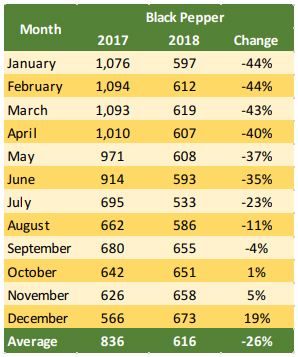
In 2018, the average local price of black pepper was reported at LKR 616 per Kg, recording a decrease of 26% as compared to the average price in 2017. In 2017, the highest local price of Sri Lanka black pepper was reported to have reached LKR 1,094 per Kg (Feb 2017), whereas in 2018 the highest average local price was only LKR 673 per Kg (Dec 2018), recording a 38% decrease as compared to the highest average price in 2017 (Table 11).
Table 11. Monthly Average Local Prices of Pepper in Sri Lanka
Source:
- Brazil, Unofficial source (Coreimex, CSG Trade)
- India: AISEF, NCDEX, Indian Chamber of Commerce & Industry
- Indonesia: Unofficial source
- Malaysia: Malaysian Pepper Board
- Sri Lanka: Department of Export Agriculture
- Viet Nam : Viet Nam Pepper Association, HCMC
- China: Hainan Pepper Association, China Spice Association
- A.A. SAYIA & Company
- International Trade Centre (ITC) - Geneva
Note: Some of the data in this publication are from the IPC database. The data are obtained from official reports and correspondence between the IPC and Sri Lanka and have been processed based on statistical norms that can be accounted for.
Previous Publications
- Market Review - July 2015
- Market Review - June 2015
- Market Review - May 2015
- Market Review - April 2015
- Market Review - March 2015
- Market Review - February 2015
- Market Review - January 2015
- MARKET REPORT 2014
- Market Review - November 2014
- Market Review - October 2014
- Market Review - September 2014
- Market Review - July 2014
- Market Review - June 2014
- Market Review - April 2014
- Market Review - February 2014
- Market Review - December 2013
- Market Review - November 2013
- Market Review - August 2013
- Market Review - June & July 2013
- Market Review - May 2013
- Market Review - April 2013
- Market Review - March 2013
- Market Review - February 2013
- MARKET REVIEW 2012
- Market Review - November 2012