a UNESCAP Intergovermental Organization
a UNESCAP Intergovermental Organization
Monthly Publication
MARKET REVIEW - August 2019
PRICE HISTORY
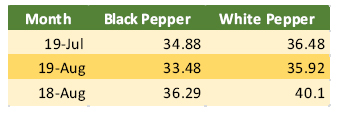
August 2019, price index was reported with a negative outlook. Price index of black pepper recorded a drop of 4% as opposed to the previous month. Recording an 8% drop when compared with the same period in 2018. Slightly better than black pepper, price index of white pepper was reported with a mere 0.56 points loss as compared to the previous month at 35.92 points (Table 1). Though, when compared with price index of white pepper in August 2018 it recorded a 10% loss.
Table 1. IPC Price Index (Base price: Average 2011-2015)
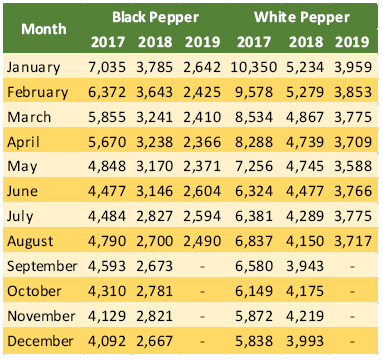
August 2019 recorded a drop in the composite price of black and white pepper respectively. Composite price of black pepper was reported with a deficit by USD 104 per Mt as opposed to the previous month and was reported at USD 2,490 per Mt (Table 2). Composite price of white pepper was also reported with a deficit, recording a slight USD 58 per Mt deficit when compared with July and was reported at USD 3,717 per Mt.
Table 2. Composite Price of Black and White Pepper (US$/Mt)
Pepper prices in 8th month of 2019, showed a mixed response with a rather negative outlook as only China origin was reported with a slight increase and Malaysia origin was reported with the biggest drop as opposed to the previous month.
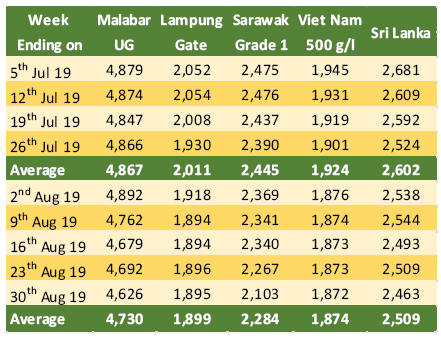
The farm gate of black pepper in India was reported at an average of USD 4,730 per Mt (Table 3). Thus, recording a 3% deficit when compared with July 2019. The decrease in price of black pepper in India could be contributed to the decrease of the price in the local currency with an average of INR 335 per Kg in August 2019 which could be contributed to the smuggled pepper from other market (economictimes.indiatimes.com). The price of black pepper in Indonesia (Lampung black pepper) had also weakened when compared to July 2019. The farm gate of Lampung black pepper for August 2019 was reported to be at USD 1,899 per Mt, recording a decrease of USD 112 per Mt or 6% as compared to the previous month. The decrease in price of black pepper in Indonesia could be contributed to the abundance of supply as the harvest came to full swing, thus, pushing the local price to an average of IDR 27,000 per Kg and other contributive factor was the weakening of Indonesian Rupiah against US Dollar. Following the end of harvest, the farm gate price of black pepper in Malaysia recorded a significant deficit. In August 2019, the farm gate of black pepper in Malaysia was reported at USD 2,284 per Mt, recording a deficit by 7% as compared to July 2019. The farm gate price of black pepper Malaysia in the local currency dropped to an average of MYR 9,500 per Kg from MYR 10,059 per Kg in July 2019. Aside from the result of harvest, the decrease of Malaysian black pepper was also aligned with the weakening of Malaysian Ringgit towards US Dollar (averaging at MYR 4.19 for USD 1). Farm gate price of black pepper in Viet Nam for August 2019 was reported to have decreased by 3% as opposed to previous month averaging at USD 1,874 per Mt. As result of the end of harvest period in Sri Lanka, August 2019 saw the farm gate price of black pepper in Sri Lanka decreasing by 4% as opposed to the previous month and was reported at USD 2,509 per Mt.
Table 3. Farm Gate Prices of Black Pepper (US$ per Mt)
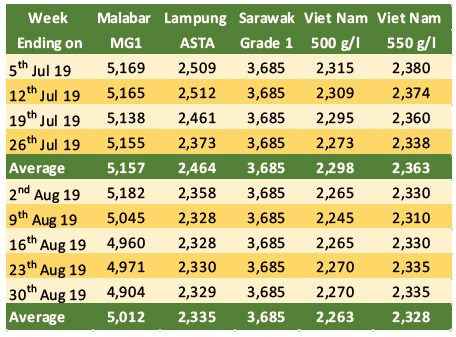
FOB price of black pepper was reported to have experienced the similar response as farm gate prices (Table 4). The weakening of Indian Rupee towards US Dollar pushed down the FOB price of black pepper in India by 3% as compared with the previous month and was reported at an average of USD of 5,012 per Mt. Furthermore, the FOB price of black pepper in Indonesia was also reported to have decreased by 5% as opposed to previous month averaging at USD 2,335 per Mt. FOB price of Malaysian black pepper was reported stable at an average of USD 3,685 per Mt. Meanwhile, FOB price of Viet Nam black pepper 500 g/l and 550 g/l were reported with a decrease of 2% and 1% as compared to the previous month with an average of USD 2,263 per Mt and USD 2,328 per Mt respectively.
Table 4. FOB Prices of Black Pepper (US$ per Mt)
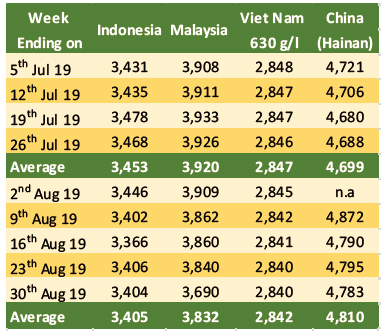
Farm gate prices white pepper from all origins showed mixed response (Table 5). As Indonesian harvest of Muntok white pepper came to full swing, Muntok white pepper was reported with a slight 1% decrease as compared to the previous month and was traded at an average of USD 3,405 per Mt. In local currency, the price of Muntok white pepper was reported at an average of IDR 48,300 per Kg. As result of the end of harvest period, farm gate price of Malaysia white pepper was also reported with a deficit by 2% as compared with the previous month and was traded at an average of USD 3,832 per Mt. Furthermore, Viet Nam white pepper was reported stable at an average of USD 2,842 per Mt. Whilst, China white pepper was traded with a 2% increase as opposed to the previous month at an average of USD 4,810 per Mt.
Table 5. Farm Gate Prices of White Pepper (US$ per Mt)
FOB price of white pepper showed mixed responses. FOB price of white pepper in Indonesia for August 2019 was reported with a slight deficit by 1% when compared to July 2019 and was reported at an average of USD 4,025 per Mt. Furthermore, FOB price of Malaysia white pepper was reported stable and unchanged. Whilst, Viet Nam FOB price of white pepper recorded a decrease of USD 35 per Mt or 1% as compared to the previous month averaging at USD 3,413 per Mt. FOB price of white pepper in China was reported with a slight increase of 1% when compared to the previous month and was traded at an average of USD 5,010 per Mt (Table 6).
Table 6. FOB Prices of White Pepper (US$ per Mt)
HIGHLIGHT ON CAMBODIA
Production and Productivity
Cambodia, officially the Kingdom of Cambodia is a country located in the southern portion of Indochina peninsula in Southeast Asia. Cambodia has a tradition of more than 700 years and a natural comparative advantage in black pepper cultivation and has an excellent climate and soil conditions for pepper, especially for organic pepper. During the French colonial times so-called Kampot Pepper developed a reputation for its special taste. Kampot Pepper takes its name from the province of Kampot, in south-west Cambodia. The pepper growing area of Kampot covers six districts located in the province of Kampot. As pepper sector contributes to Cambodia's economic development, increase farmers' income, reduce poverty and with potential to increase exports and value addition, the Royal Government of Cambodia has defined black pepper as a product priority among 19 goods and services to be developed and strengthened.
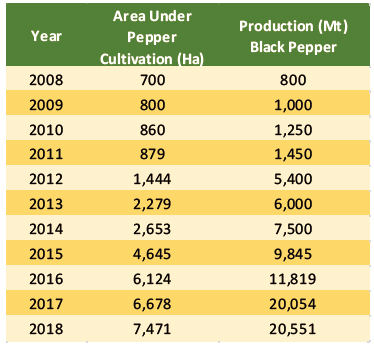
Since 2008, the area under pepper cultivation in Cambodia had shown a rapid increasing trend. In 2018, Cambodia planted pepper on 7,471 Ha of area, recording an increase 6,771 Ha of area when compared to 2008 (Table 7).
Furthermore, Cambodia pepper production was reported fluctuating in the past 11 years with the highest yield reported to be in 2018, totalling at 20,551 Mt while the lowest yield was reported in 2008 with only 800 Mt. Thus, recording an increase by 19,751 Mt when compared to 2008. Cambodia's pepper production has been rising quickly in recent years in response to higher prices which were driven by rising demand and speculation. In the span of 11 years pepper production in Cambodia was reported with major spikes in 2012 with 272% increase recorded and in 2017 with a 70% increase recorded. Furthermore, as farmers reacted to low price, growth of pepper production in 2019 is expected to slow down.
Table 7. Area under Pepper Cultivation and Pepper Production
Source: Ministry of Commerce, Cambodia
Pepper productivity in Cambodia in the past 11 years was reported fluctuated. From 2008 until 2018 pepper productivity in Cambodia was reported with a major increase by 141% or 1,608 Kg per Ha. Furthermore, the highest pepper productivity in Cambodia was reported in 2012 with 3,740 Kg per Ha. In 2018, pepper productivity in Cambodia was reported with a decrease by 8% as compared with the previous year at 2,751 Kg per Ha (Chart 1).
Chart 1. Pepper Productivity 2008-2018
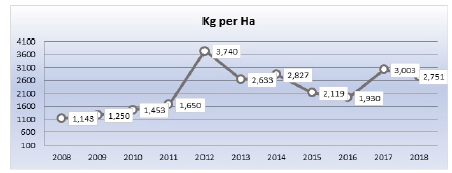
*Note: Productivity = Total production (Kg)/Area under pepper cultivation (Ha)
Pepper Export from Cambodia
Known as the origin of Kampot pepper, Cambodia export pepper has steadily increasing in the past 8 years though still in smaller scale. Since 2008 until 2018 there had been of 496 Mt increased of pepper exports from Cambodia both for whole and ground pepper (Table 8) which amounted to 498 Mt. The highest quantity of pepper export from Cambodia was reported during 2014 which amounted to 1,061 Mt which comprised of whole pepper only, recording an increase by 45% as opposed to the previous year.
Year 2018 saw a slight decrease in terms of export by Cambodia. Cambodia was reported to have exported a total of 498 Mt which comprised of 493 Mt of whole pepper and 5 Mt of ground pepper. Thus, recording a decrease of 4% or 20 Mt as compared with the previous year.
Aside from the documented trade of pepper, Cambodia had also recorded a quite significant undocumented and informal trade to its neighbouring countries which caused unfair competition and value loss.
Table 8. Export of Pepper 2008 - 2018
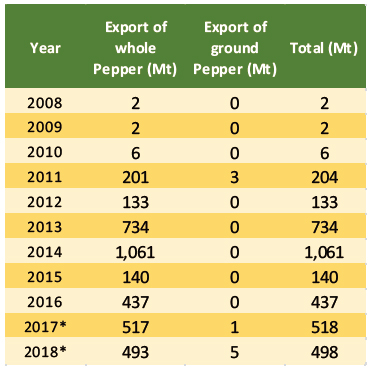
Source: International Trade Centre (ITC) - Geneva * mirror data
Chart 2. Export of Pepper 2008-2018
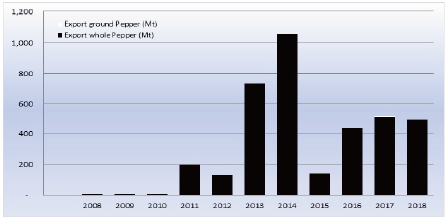
Pepper from Cambodia both whole and ground is exported to various countries throughout the world with main destination European countries. In 2018, Cambodia was reported to have exported a total of 492 Mt. The total revenue of Cambodia export in 2018 was reported to be as high as USD 2.9 Million, thus, recording an average price of the total pepper exported by Cambodia at USD 5,852 per Mt.
Furthermore, in 2018, Cambodia's top 5 country destinations for pepper were reported to be Germany with 233 Mt (approximately 47% of the total pepper export by Cambodia), Italy with 73 Mt (15%), Portugal with 45 Mt (9%), Taiwan with 35 Mt (7%) and Poland with 28 Mt (6%) (Table 9).
Table 9. Export of Pepper 2018
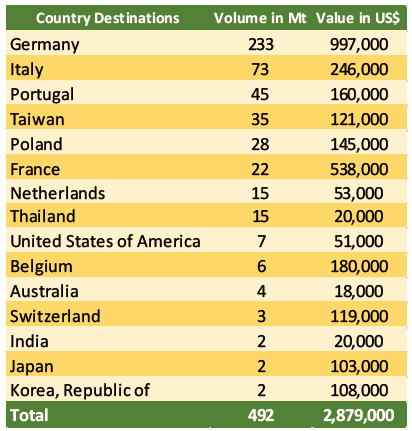
Source: International Trade Centre (ITC) - Geneva
Source:
- Brazil, Unofficial source (Coreimex, CSG Trade)
- India: AISEF, NCDEX, Indian Chamber of Commerce & Industry
- Indonesia: Unofficial source
- Malaysia: Malaysian Pepper Board
- Sri Lanka: Department of Export Agriculture
- Viet Nam : Viet Nam Pepper Association, HCMC
- China: Hainan Pepper Association, China Spice Association
- A.A. SAYIA & Company
- International Trade Centre (ITC) - Geneva
Note: Some of the data in this publication are from the IPC database. The data are obtained from official reports and correspondence between the IPC and Sri Lanka and have been processed based on statistical norms that can be accounted for.
Previous Publications
- Market Review - July 2015
- Market Review - June 2015
- Market Review - May 2015
- Market Review - April 2015
- Market Review - March 2015
- Market Review - February 2015
- Market Review - January 2015
- MARKET REPORT 2014
- Market Review - November 2014
- Market Review - October 2014
- Market Review - September 2014
- Market Review - July 2014
- Market Review - June 2014
- Market Review - April 2014
- Market Review - February 2014
- Market Review - December 2013
- Market Review - November 2013
- Market Review - August 2013
- Market Review - June & July 2013
- Market Review - May 2013
- Market Review - April 2013
- Market Review - March 2013
- Market Review - February 2013
- MARKET REVIEW 2012
- Market Review - November 2012